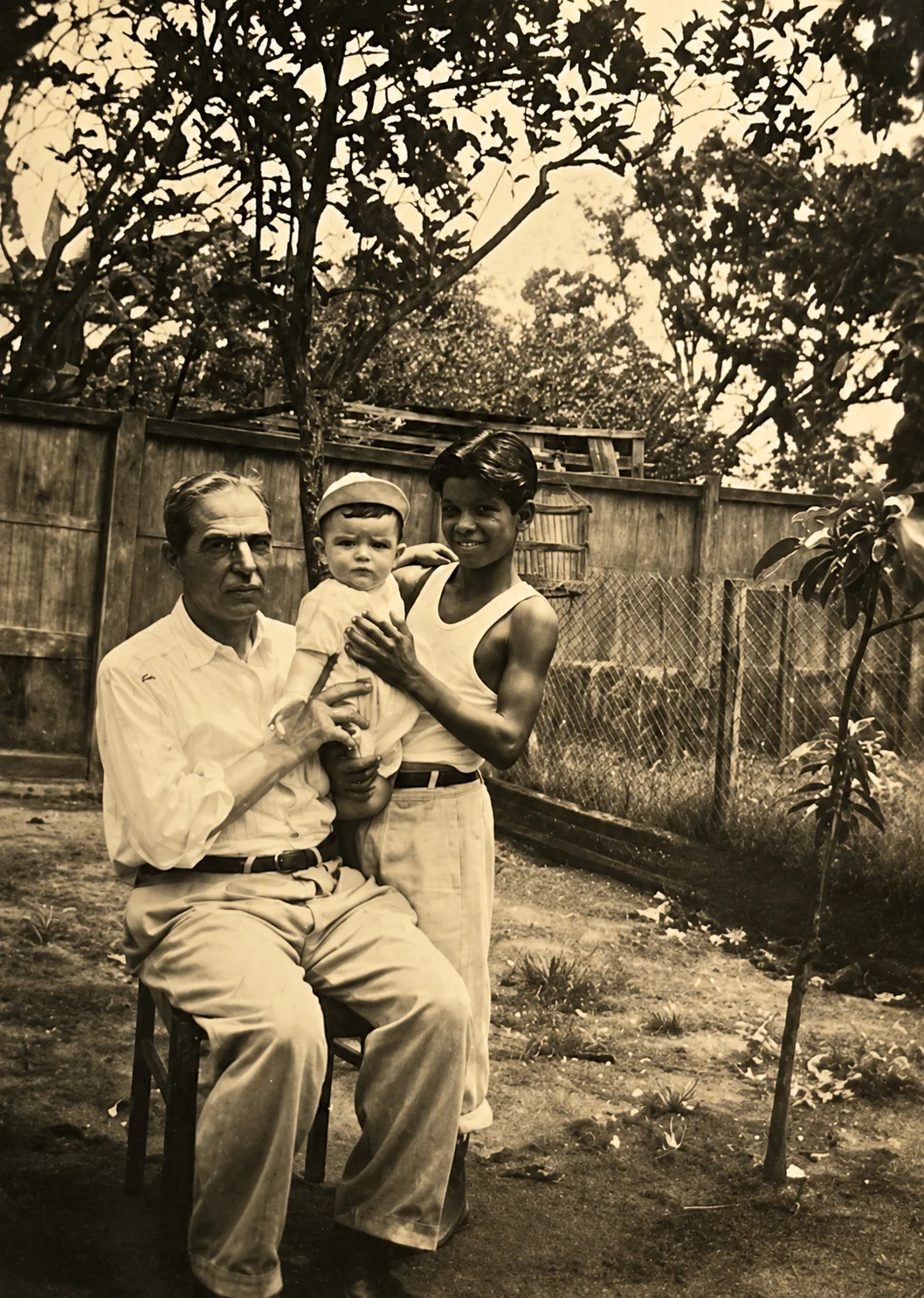
When the family of Manuel Bernardes came to me, the case looked entirely simple. They were the grandchildren of a Spaniard they had known personally, and they held a vivid image of their grandfather. The waiter who crossed the Atlantic while still very young, who dreamed of opening a restaurant in Rio de Janeiro and who retired after a lifetime of waiting tables. They joked that his wish was for his sons to be waiters too. And, above all, they came to me with the thing every researcher likes to hear in an initial conversation: a specific place of origin. Their grandfather was from Lalín.
Above: Manuel Alberto Bernardes, family photograph, reproduced with permission.
A specific place-name changes the whole search. Let me explain why. When a descendant tells me an ancestor was from Pontevedra, from Coruña or from Granada, I grow wary before I celebrate, because in Brazilian documents, in foreigner registration records and in registry entries, the most common practice was to record the province, not the municipality. Lalín is different. Lalín is a municipality with a specific name, and a specific name tends to open the door rather than close it. That is why the case seemed solved before it had even begun.
The chain of negative searches
I began the natural way. Since Manuel was born after civil registration had come into force, I requested his birth certificate. The search came back negative. We were at the height of the Democratic Memory Law, and obtaining records was unusually difficult. A negative result, at that moment, settled nothing, so I moved on to the baptism. I approached the parish, which told me it did not hold the books. I turned to the diocese, which, with its enormous volume of requests, was slow to answer, and the diocesan search also came back negative. I mapped the historic parish and administrative boundaries, the small churches around what had once been Lalín, and one negative result followed another.
When everything fails, the first suspicion falls on the registry office itself. Did they not look properly? Was the date of birth wrong, since he had come as a child and that kind of error happens? I tested each of these hypotheses. And it was in testing them that I noticed the obvious thing that had escaped me. I had never seen a single document in which Manuel said he was from Lalín. Soon afterward a reference to Pontevedra surfaced in a document, and there I fell into the old trap once more. Town or province? I requested the city of Pontevedra. Negative. I looked for the baptism. Nothing. A dead end.
The myth no one had heard
It is in this kind of impasse that I turn to a rule that governs my work. The document we are looking for is almost always preserved, without anyone realizing it, in the memory of an ancestor, and the family must be listened to with care. I gathered the family again. They told me their grandfather had never been much of a talker. I asked where the Lalín story had come from. The answer was revealing. A cousin had been the source of the story. No one had ever heard it from Manuel’s own mouth.
At that point I already knew what had happened. It is what I call the crystallization of a family myth. A piece of information stated once, without documentary basis, that hardens over time and comes to circulate as truth. Lalín was exactly that. But I kept asking questions, because family stories often preserve, without anyone realizing it, the clue that unlocks the case. And it came. Grandfather had a cousin, Adolfo, of whom he always spoke. They had arrived very young, together, to work at the port.
That, to me, was not an anecdote. It was method. Urban migration often follows what historians describe as chain migration. There is usually an initial migrant who goes first and becomes the anchor for relatives and countrymen, drawing them to the same destination and the same trade. Many of the Galicians who went to Montevideo found work as drivers. Galician migration was rarely solitary. One migrant helped draw relatives and countrymen into the same place and occupation. If Manuel came with his cousin to work at the port, the cousin was a thread to pull, and the origin of the two was likely the same. I already knew, from the children’s records and the marriage certificate, that he had lived in and around Rio’s port district. Everything pointed to the same territory. And I knew he was from Pontevedra.
To seek the pattern, not the man
Except that Manuel was a hard man to trace. In every document he appears as Manuel Bernardes, son of Manuela Bernardes. The son of an unmarried mother, with a single surname, and a surname that was common across the region. The mother, too, appeared only as Manuela Bernardes, without the second surname that would allow cross-referencing. What was missing, in short, were the anchors that narrow a search.
Faced with this, I inverted the problem. Instead of chasing the document of a man without anchors, I reconstructed the migration pattern he belonged to. I gathered the studies on the Spanish presence in the port district of Rio de Janeiro, investigated where those workers came from, and drew up a list of the main towns in Pontevedra that supplied this migration stream. I identified about ten towns. At that time I was in Spain myself, near the archives, able to travel to them in person. But the deadline was short, the client already had an appointment scheduled, and Manuel was one of roughly three hundred active cases at the time.
So I made a decision. Instead of choosing one town and staking everything on it, I sent requests for the birth certificate to all ten towns at once. If the first attempt failed, I could still go in person. I put a tracking table on the wall and waited. Civil registry replies can take time. Two quick negative searches came back, which ruled out nothing, because the age might be wrong and the search might have covered only a narrow band of years.
Then came a positive reply, with a certificate attached, and there it was written, Manuel Bernardes. Except that the certificate came back with a problem. Two pages, and the new barcode of the Spanish system stamped right over the mother’s name. I could read the surname Bernardes, I could confirm the unmarried mother, but her first name vanished beneath the strip. And there was more. A death annotation, with a date, stating that this person had died. The dates suggested that he had died young, which opened the door to all manner of speculation. Had he migrated and later been recorded as dead back home? I then had to ask the registry to reissue the document and clarify what had been obscured.
What the method found
The reply undid the knot at once. It was not my Manuel. It was another Manuel Bernardes, the son of another unmarried mother, born in the same year, in the same region. The death annotation belonged to a namesake. What had seemed the climax of the investigation was nothing more than a coincidence of name and year.
I confess that, when a case turns like this, the first word that comes to mind is luck. But it is not luck. Because I had mapped ten locations and contacted them in parallel, one of the later replies eventually matched every known detail. Luck is merely the name we give to method when it works.
With the correct record in hand, I discovered that the name was a compound one. Manuel Alberto Bernardes. And the full name unlocked the rest. I located the boarding record, and the life reassembled itself before me. A young man who left his mother and migrated at seventeen, together with his cousin and other young people from the same village, to Rio de Janeiro, where his cousin was already established. He reached the city and went to the port district, because it was there that the cousin had arranged work for him and for the others. Later he settled into work as a waiter, and never strayed far from the surroundings of the port.
There is one detail that stays with me. Manuel was the son of an unmarried mother and never hid it. He could have done as so many did who, on settling on the other side of the ocean, rewrote their own lives, invented a father, adopted a more comfortable surname, gave themselves an origin without rough edges. He did none of that. He carried, with his head held high, what his time insisted on treating as a stigma. And the family, who had come to me with a crystallized myth, the Lalín of a cousin, saw the ancestor come into focus, with a full name and a documented life.
Cases like Manuel’s remind me why the word history holds, at its root, the idea of inquiry. Every serious piece of research is almost a thesis. It begins with a hypothesis, withstands a chain of negative results, corrects its course when the facts demand it, and concludes only when the right document appears. The family myth has its worth, for it holds affection and memory, but it does not replace the record. And often, what it hides is a story even more beautiful than the one that was being told.
Mnésis, documentary, genealogical, and historical research. From your roots to your future.