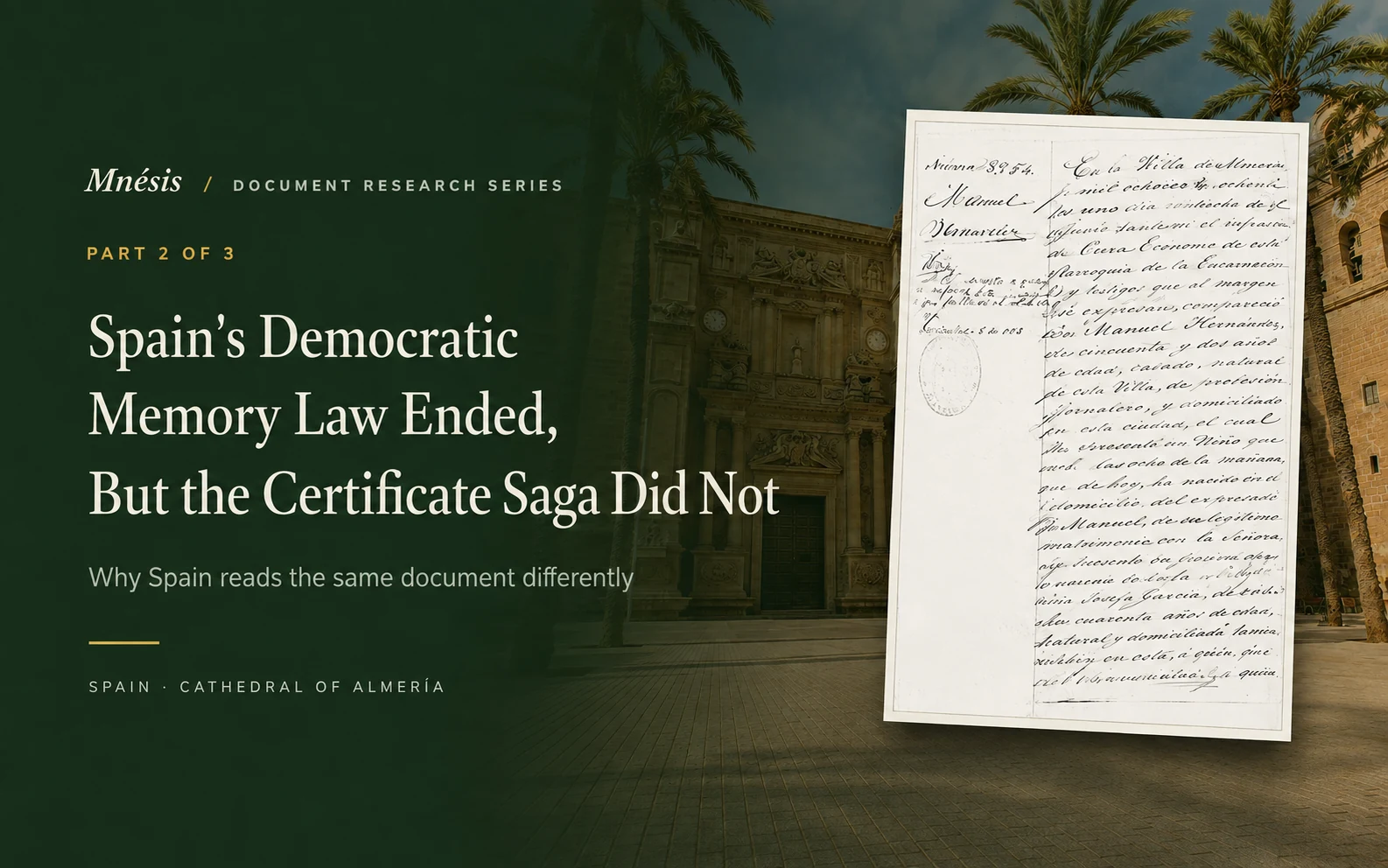
In the previous article I left a question open: if Spain accepts the baptism and corroborating evidence exactly where Portugal simply says no, why? The answer is historical, and that is what I want to talk about now. But first I have to tell you where I am speaking from, because it changes the weight of everything that follows.
The Democratic Memory Law was one of the greatest challenges of my life as a historian. I had to move to Spain to keep up with the number of clients I had. And what I saw from the inside explains the whole article.
A law too broad for the structure that existed
The Democratic Memory, the Memoria Democrática, was an unusually broad transitional law. It let grandchildren, great-grandchildren and great-great-grandchildren of Spaniards claim nationality, a reach Spanish law had never had. Historically, the Spanish rule was to register the child of a Spaniard, and at most some transitional law reached the grandchild. Suddenly, entire generations who did not even know they had a right were eligible.
The Spanish State, with every good intention, did not gauge the magnitude of what this would generate. And the registry offices were not prepared. Picture the scene: towns of two or three hundred people, many of them the very origin of the great Spanish migratory waves, that had never in their lives needed to issue a certificate for someone abroad. No staffing, no physical structure, and in some cases, and I am not exaggerating, no email address. Some registry offices accepted requests only by post. It became chaos, and it was inside that chaos that I worked.
That operational saga would fill an article on its own, and perhaps it will. Here I bring only enough for you to understand that what I am about to explain, I saw happen. I did not read it in a manual.
The law ended, but the searches did not stop
Here is the first thing that confuses the client. The Democratic Memory Law closed the window for applications, so many people assume it is all over. It is not. Because of the enormous volume of requests, what happened was this: people filed to request an appointment, and that appointment, at many consulates, was scheduled years ahead. In Rio de Janeiro there were appointments set for 2028. And it is only on the date of the appointment that the person presents the documentation.
In other words, many applications remain pending with the document search still to be done, because assembling the documents is a second stage that only comes due much later. That is why we are still, today, locating birth and baptism records for the Democratic Memory. The law ended. The saga of the certificates did not.
Why Spain reads the document differently
Now, the answer to the question from article one. And it is, at bottom, a matter of origin.
In Portugal, it is extremely rare for an archival collection to have been destroyed. We may fail to find a record for several reasons, the right book, the right parish, the right date, but those records generally survive somewhere. In Spain, no. The Spanish Civil War burned churches and, with them, entire parish registers. It burned town halls, the ayuntamientos, and, with them, entire civil registries, wiped out going back to the creation of the Spanish civil registry in 1871. This is not rumor or family legend. I walked through the Spanish civil registries myself, and I hold certificates that declare, in writing, the destruction of the books.
And that is the difference that explains everything. Spain accepts more because Spain lost more. The Spanish State recognized, within itself, its own limitations. It knows that demanding of a descendant a document the country itself burned would condemn them to an impossible process. Portugal, which preserved its records, never had to develop that documentary humility. And there is the root of the contrast: one country loosens the rules because it lost, the other tightens them because it kept.
What Spain accepts as proof of the ancestor
When the Democratic Memory came, Spain built into law what Portugal refuses. To prove the Spanish ancestor, a great deal counts.
The baptismal record counts. The birth record counts. And, the strongest point, the reconstruction of the record counts. If I find no baptism and no birth record, I can file a court action in a Brazilian court, because Brazilian law provides for it, and reconstitute the record from corroborating documents. That reconstructed record was accepted under the Democratic Memory Law.
Pay attention to this detail, because it is the heart of the series. In article one, I explained that the Portuguese conservatória, the civil registry office, accepts reconstruction only when it rests on an original document, and does not accept a reconstruction built from corroborating documents. Well, it is exactly that reconstruction from corroborating documents, the one Portugal rejects, that Spain accepted. The same proof, two opposite answers.
And there is an elegant symmetry in the case of the baptism. In Spain, to use the baptism, you have to present the certificate of no record from the civil registry, the one attesting that the record is not there. The same requirement Spain makes inside its own territory, it carried over to the foreign descendant. I locate the baptism, request a civil-registry search, obtain the certificate of no record, and submit both together.
A domestic solution exported to the world
And here is what closes the thesis. Spain did not invent a generous rule to please foreigners. It took the solution it already used at home, born of its own loss of records, and mirrored it outward.
Because Spain reconstructs records within its own territory, and has a specific instrument for it: the out-of-term birth registration, with its variant for people already deceased, the post mortem registration. It is the procedure that allows a birth record to be created for a Spaniard who was never baptized or registered, provided it is proven, through corroborating documents and testimony, that they were born in that locality. It is exactly the same logic as the Brazilian reconstruction: start from the documents that survived to rebuild what was lost. Spain does this at home, and so it had no difficulty accepting that the same be done abroad, in Brazil, Argentina, Mexico, Venezuela, Cuba, in practically every destination of the mass Spanish emigration, the places where the Democratic Memory rush happened.
So Spanish flexibility is not kindness. It is a nation recognizing that its own papers did not survive, and acting with consistency: if I lost my records, and if I myself reconstruct them when I need to, I cannot demand of my descendant what I do not demand of myself. It is that logic, and not some supposed generosity, that sets the Spanish process apart from the Portuguese.
The bridge to Italy
So the distinction is now sharp. What Spain accepts through corroborating documents, the reconstruction, the baptism with a certificate of no record, the birth record, is exactly the ground on which Portugal shuts the door. Not because one country is better than the other, but because each carries a different documentary history and legislates from it.
And Italy? The Italian view, on this point, is very close to the Spanish one. It too accepts reconstruction, it too trusts corroborating evidence to separate the legitimate case from the fraudulent one. But it has a particularity that sets it apart: in Italy, reconstruction is always judicial. It is the court action above all else. Where Spain resolves a great deal through the registry, with its own procedures, Italy takes it to the judge. That is what the third and final article in this series is about: the judicial logic of the Italian process, and what it means for your ancestor's documents.
From your roots to your future.