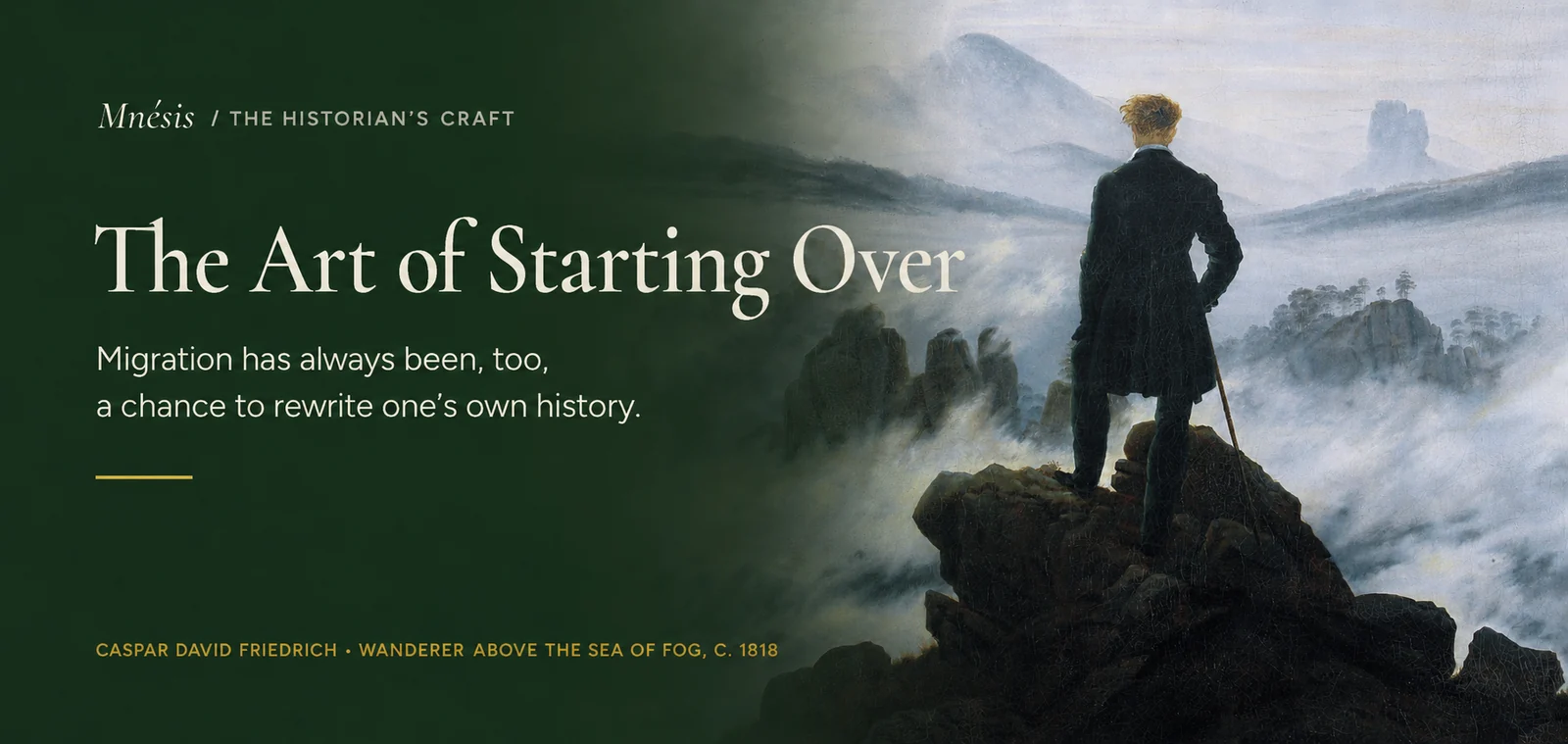
There is a truth about immigration that is seldom said aloud. Migration was never merely a change of place. It was, almost always, the chance to start over. To leave behind not only the land, but the stigmas their communities imposed on them, the prejudices, the marks that a small and watchful society imprinted on each person and would not let fade. Whoever departs carries luggage, but has, for the first time, the possibility of choosing which parts of that baggage to unpack on the other side.
This is as true today as it was a century ago. An immigrant who leaves a poor country in search of better conditions in Europe, a Latin American who starts over far from home, also reconstructs a narrative. Today it is hard to forge a document, and that is not what I mean. But the story one tells to the new world can omit, without lying, the suffering, the humble origins, the situations one would rather not relive. Omission is an old and human way of starting over. For the historian, those omissions leave distorted and uneven traces.
The most eloquent case of this, in my work, is that of the child born outside marriage, historically called a natural child.
The father one invented
In earlier Portuguese, Italian and Spanish societies, to be the child of an unmarried mother was a stigma carried for a lifetime, written into one’s own birth record. To cross the ocean was, for many of these children, the chance to be rid of it. They often arrived without documents, and in a period when family facts could be established through declarations supported by witnesses, a person could sometimes supply a father’s name without presenting an original record. So, on marrying in the new land, a natural child could simply state the name of a father. He invented one. He gave himself a lineage that the record of origin had never registered. I do not say this as one who judges. I say it as one who understands. It was the reconstruction of a life, the chance to start with a clean slate.
The problem is that this reconstruction, made a century ago, lands today on my desk as a false lead. The invented father sends me searching for a man who never existed. It generates an entire search for a shadow. And what distinguishes the experienced researcher is learning to recognize, in the documents themselves, the signs that this father may not be real. These are not universal rules. They are warning signs.
The signs
The first is an imprecise account of the father’s death. When, in a certificate, the father appears as having died in Portugal many years ago, without a date that can be fixed, a warning goes off. Note the logic. If the immigrant departed as a child, he may genuinely not remember, and the imprecision is explained. But if he was already a grown man, he usually has at least some notion, and the documents show it all the time, died twelve years ago, died five years ago. The total absence of a time frame, the impossibility of situating that death even approximately, is a factor that carries weight. A father who died in no place, in no time, is sometimes a father who did not die because he never existed.
The second is subtler, and one of the most useful in practice. In the Portuguese naming tradition, the great majority of women did not take their husband’s surname. So, when I find a certificate in which the groom is Manuel da Silva Correia, the supposed father is also Manuel da Silva Correia, and the mother, born in Portugal, appears as Amélia Correia or Francisca Correia, carrying the husband’s surname, something does not add up. That family, too neatly aligned, gives itself away. One explanation I have encountered repeatedly is an immigrant recasting his family history in Brazilian terms. By giving the mother a husband’s surname, he builds for himself the appearance of a legitimate child. And often he does so without malice, because he came young and assumed that the Brazilian custom, that of the woman taking the husband’s name, held also in the land he barely knew. The cultural error, unwittingly, gives the invention away.
The third is the contradiction between documents. An invented detail rarely remains consistent across every record. I have had many cases in which the man declared, at his own marriage, that the father was Francisco Correia, and years later, in a child’s record, gave the name Antônio Correia. He had forgotten the father he had invented. Whoever reads the documents side by side, and not one at a time, finds these seams.
And there is a fourth path, when one moves from the civil sphere to the religious. The two do not always match, and that is where the discovery lies. For a religious marriage to take place, an ecclesiastical marriage file was required, just as in the civil sphere, and in that file there appears, often, a precious piece of information, the parish where the groom was baptized. Frequently the process itself requested the original baptismal record from the parish. And it is there, in the paper coming from the parish, that the original record can reveal the discrepancy clearly. The man who in the civil record called himself a legitimate child appears, in the baptism, as a natural child. The religious sphere kept what the civil one allowed to be rewritten.
Not every invention is a lie
I must say one thing, because honesty is what sustains this work. Not every declared father is false, and not every declaration is entirely false. A man could know perfectly well his own father’s name, could have known him in a small village, and still not have been registered by him, because the parents did not marry and there was no recognition. That man carries the true name of the father without being, on paper, his legitimate child. That is why, when this name appears, I do not discard it. Sometimes I use it as a search lead and find it in a village, and that becomes a clue to search precisely there. Only I change how I search. I stop hunting for a child, an Antônio son of a Francisco, and begin to look at every Antônio in that place, because he may well have been born to an unmarried mother, and that is precisely why he was not where I looked for him. Often, indeed, I prefer to search by the mother’s name than by the father’s. In these cases, the mother’s identity is often the more reliable anchor.
Those who depart alone
It is worth noting that this opportunity to reinvent oneself did not arise equally in every migration pattern. It was stronger where migration was individual. Some migration streams involved entire families. Spanish immigration, often, brought whole families at once to work the fields, and the Italian too came largely that way. The Portuguese followed another path. It was common for the man to depart alone, even when married, to go ahead, assess opportunities and establish himself, and only after years send for the family left behind. Now, whoever arrives alone in a land where no one knows him has, more than anyone, the blank page to rewrite who he is.
And not all sent for the others. There were those who built a new family here and left the old one on the far side of the sea, abandoned, without news. On that side, the wife and the children came to believe that he had died, that some misfortune had taken him. Families spent eight, nine, many years without a reunion that, sometimes, never came. The man who was presumed dead in Portugal, or who allowed those at home to believe he had died, could begin again on the other side, with another father’s name and another story.
It is for all of this that I say, without irony, that to migrate is also the art of reconstructing oneself. Every certificate that rewrites an origin holds, beneath the invention, a person who wished only to begin again with a clean slate, free of a weight they had not chosen to carry. My craft is not to unmask that person. It is to understand why they did what they did and, with patience, to recover the history they concealed, without ever losing respect for the reason that led them to hide it. The invented origin is, itself, a document. It says little about where someone came from, and much about what that person wished to be.
Mnésis, documentary, genealogical, and historical research. From your roots to your future.