Three of the great Portuguese migration stories in the United States unfolded in very different ways. In New Bedford, Massachusetts, the Portuguese came for the whale and stayed in the textile mills. In the Sacramento Valley, they came for gold, and from gold moved on to land, cattle, and politics. In San Diego, at the far southern edge of California, the story is different: there the Portuguese came by sea and stayed at sea, and ended up creating, out of nothing, an industry that fed the world.
Who came, and why
The Portuguese presence in that bay is older than California itself. On September 28, 1542, the navigator João Rodrigues Cabrilho, a Portuguese in the service of the Spanish Crown, was the first European to enter the bay of San Diego, rounding the peninsula now called Point Loma. There, for thousands of years, the Kumeyaay people had lived. Cabrilho passed through; the Portuguese colony would come almost four centuries later, and by another route.
That route was the whale. Throughout the nineteenth century, American whaling captains sailed from New England and put in at the Azores and Cape Verde to complete their crews, recruiting there because the men were available, experienced, and cheap. The hunt had begun, in fact, in the channel between the islands of São Jorge and Pico. That was how the first Azoreans entered the United States in significant numbers: not as settlers, but as sailors. San Diego played a part in the whaling industry from 1857, peaking around 1871.
When the whale declined, the sea remained. And so did they.
The records show a Portuguese population settled at Point Loma from 1885, growing steadily into the mid-twentieth century. They came above all from the Azores, Pico, São Jorge, São Miguel, Terceira, and from Madeira; there were also mainland Portuguese and Cape Verdeans. One documented case captures the migratory logic well: in a small Madeiran village, Paul do Mar, word spread that San Diego was the lobster capital of the Pacific coast and that a Portuguese nucleus already existed there. A few fishermen came; once settled, they sent for their families, pooled their resources, and bought shares in boats. It is the classic pattern of chain migration: one person goes, and others follow, which is what explains why so many American families today descend from a single island parish.
Where they gathered
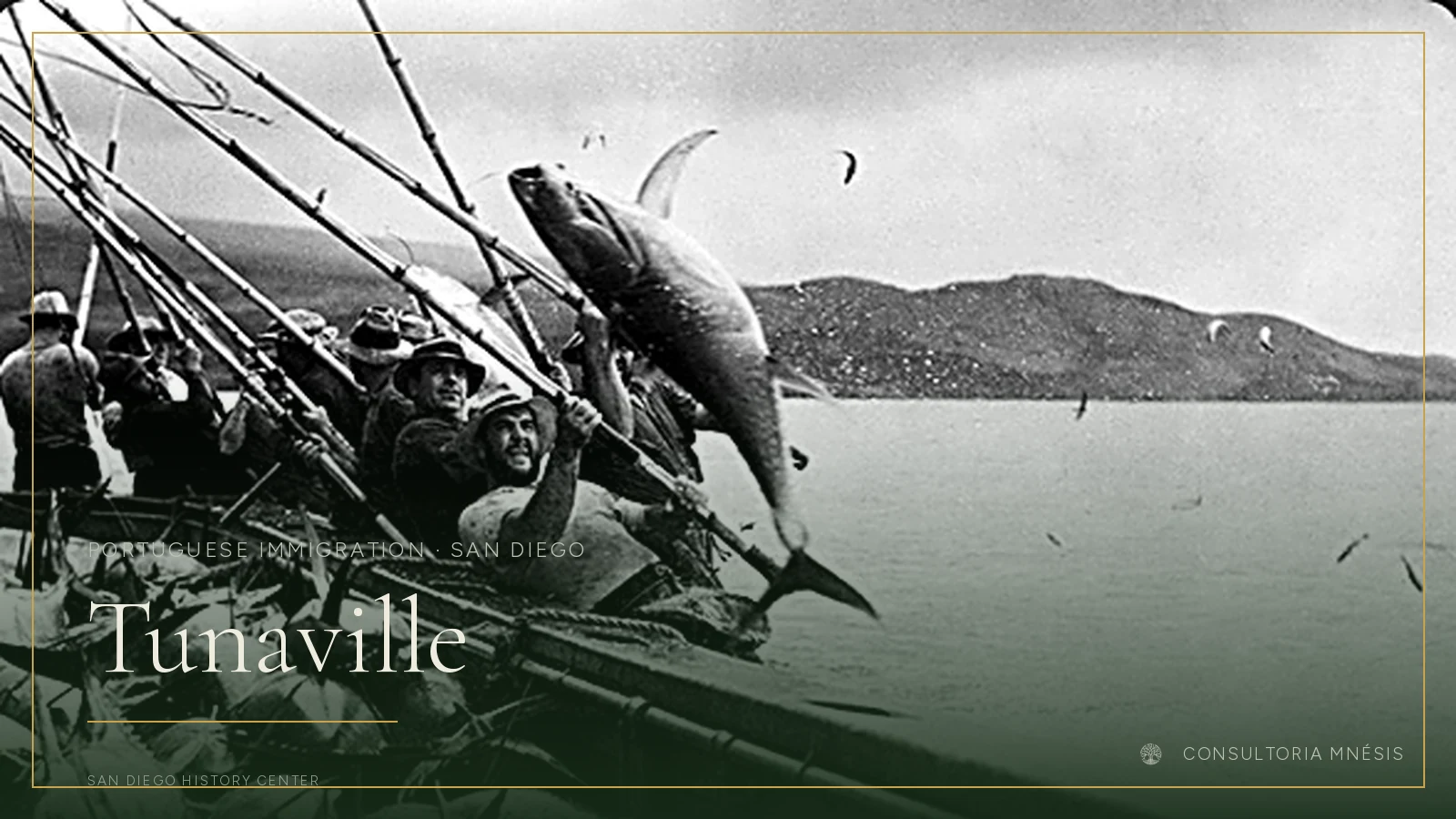
The concentration is remarkably precise, and that is decisive for anyone searching for their ancestors today. The Portuguese gathered at the far southern end of the Point Loma peninsula, in the neighborhoods of La Playa, Roseville, and later Fleetridge, the first clusters growing up at the foot of Kellogg and McCall streets. About ninety percent of the first immigrants from the Portuguese islands lived from the tuna industry. The density was such that the whole neighborhood earned its own name: Tunaville. By the 1930s, the stretch of Point Loma between Lowell and Talbot streets, running up the peninsula to Willow, was already known by it.
Anyone searching for family records should hold on to these place names: Point Loma, La Playa, Roseville, Tunaville, Shelter Island, Avenida de Portugal. It was there that the community lived, married, baptized its children, and buried its dead.
How Portuguese fishermen built an industry
The Portuguese did not integrate into San Diego simply by assimilating. They helped build one of the city's defining industries. Fishing began simply, with a line, a hook, and live bait, from small boats. It evolved into the technique that would make that fleet famous: bamboo-pole fishing, with two, three, or four fishermen lashing their poles together to haul in tuna weighing hundreds of pounds.
The central name is Manuel Oliver Medina, a native of the island of Pico. He was the man who launched the deep-sea tuna fleet of the United States, the first to have oceangoing tuna clippers built and to command them, the Oceana in 1919, followed by the Atlantic, the Mayflower, the Cabrillo, and the Normandy. By 1935, the pride of Tunaville was the largest tuna clipper in the world, the Cabrillo, 135 feet long with a capacity of 350 tons of fish. Before that, in 1897, twenty-five Portuguese fishermen had already founded their own fishing company; in 1913, José Azevedo opened the first tuna cannery, the future San Diego Packing Company. During the First World War, the demand for canned fish to supply American troops in Europe accelerated the whole industry.
The result is measurable. The San Diego tuna fleet grew to some 250 vessels, more than the rest of the world combined, and the industry became the city's second-largest economic sector, behind only defense. San Diego came to be known as the tuna capital of the world. Those fishermen are remembered locally by a phrase that defines them: men of steel in wooden boats.
The proof of belonging: 1942
There is one episode that documents, better than any speech, the degree of this community's integration. Weeks after the attack on Pearl Harbor, the United States Navy requisitioned the tuna clippers of San Diego for the war effort: they were the only civilian ships with the range, the refrigeration, and the hull to operate in the Pacific. Some forty-nine tuna clippers were mobilized to carry troops and supplies, crewed by the Portuguese fishermen of Tunaville themselves, many of whom came forward as volunteers. Fifteen of those ships were lost in the western Pacific.
An immigrant community handed its fleet and its men to the country they had made their home. It is hard to imagine a more concrete expression of belonging.
The institutions that kept the community together
Alongside the work, the community built its institutions, and it is here that the documentation of interest to descendants today is found. In 1920, Manuel Medina saw the need for a common place to celebrate the Feast of the Holy Spirit and formed a committee to raise funds across California. To build it, the boat owners each left one crewman ashore, paying him 25 cents per ton of fish. In 1922 the União Portuguesa Açoreana Sociedade do Espírito Santo was inaugurated, with a chapel and a hall. The chapel, one of only two original Portuguese chapels in California, is a faithful replica of the chapels of Terceira island. Medina was its first president, a post he held for fifty-one years. In 1948, as immigration grew, the present hall was opened. From the start, the institution welcomed Azoreans, Madeirans, and mainland Portuguese alike.
Religious life centered on St. Agnes Church, completed in 1933 with the fishermen's funding, its bell tower bearing an illuminated image of Our Lady of Safe Voyage, a permanent beacon for the boats returning from the sea. Mass is still celebrated there in Portuguese. San Diego's Feast of the Holy Spirit, more than a century old, is considered the city's oldest ethnic festival, and it keeps the Azorean devotion to the Holy Queen Isabel of Portugal and the miracle of the roses, a tradition of charity that crossed seven hundred years and an ocean.
There is also, in La Playa, a Portuguese Historical Center, and beside it a monument to the tuna industry inscribed with the names of the local Portuguese families; on Shelter Island stands the Tunaman's Memorial, dedicated in 1986. And at the tip of the peninsula, the Cabrillo National Monument marks the landing of 1542, one of the most visited national monuments in the country, and, for this community, a symbol of the antiquity of its presence.
What happened next
From the 1950s, international competition and mechanization transformed the fishing; later, environmental restrictions pushed the industry toward the South Pacific. The Tunaville fleet dispersed. The children and grandchildren of the fishermen and boat builders moved on, into real estate, business, the professions, professional sports. Over six generations, this became one of the most prosperous Portuguese communities in the United States. Many married outside the community and left the neighborhood, but they still return to the feast, to the hall, to the chapel of Terceira.
And that is where this history becomes personal, and where documentary research begins.
The documentation exists
After six generations, what is lost first is the way back. The surname has changed or been anglicized, the language is no longer spoken at home, and the name of the parish of origin has vanished from family memory. All that remains is the vague certainty that great-grandfather came from the Azores, without knowing from which island, from which village, in which year, on which ship.
The good news for family historians is that immigration generated an extraordinary paper trail. There were passenger lists drawn up at the ports of embarkation, arrival records, naturalization files, quota systems, licenses, and maritime registrations. On the Portuguese side there were the consular registration books, which functioned as Portuguese civil registers abroad, the parish records of the islands, the passport registers, and the emigration permits. There are also the archives of the brotherhoods and mutual-aid societies themselves, which recorded the birthplace of each member.
The documentation is scattered across two continents, but it is there. To gather it is the work of historical research, and it is precisely what we do at Mnésis: we have already retraced that path for Portuguese-American families, from the present-day surname to the baptismal entry in an island parish. If your family has roots in Point Loma, if one of your ancestors fished for tuna out of San Diego, or if at home it was said that your grandparents came from Pico, Terceira, São Jorge, or Madeira, that origin can be documented.
The name may have changed. The record was written, and it is still waiting for someone who knows where to look.
Mnésis, documentary, genealogical, and historical research. From your roots to your future.
Sources & Further Reading
- Portuguese consular registration books for California, which functioned as Portuguese civil registers on American soil.
- U.S. passenger and arrival records, naturalization files, and port registers for San Diego and New Bedford.
- Passport application registers of the Azores (Pico, São Jorge, São Miguel, Terceira) and Madeira.
- Records of the Portuguese brotherhoods and mutual-aid societies of Point Loma, which noted each member’s birthplace.