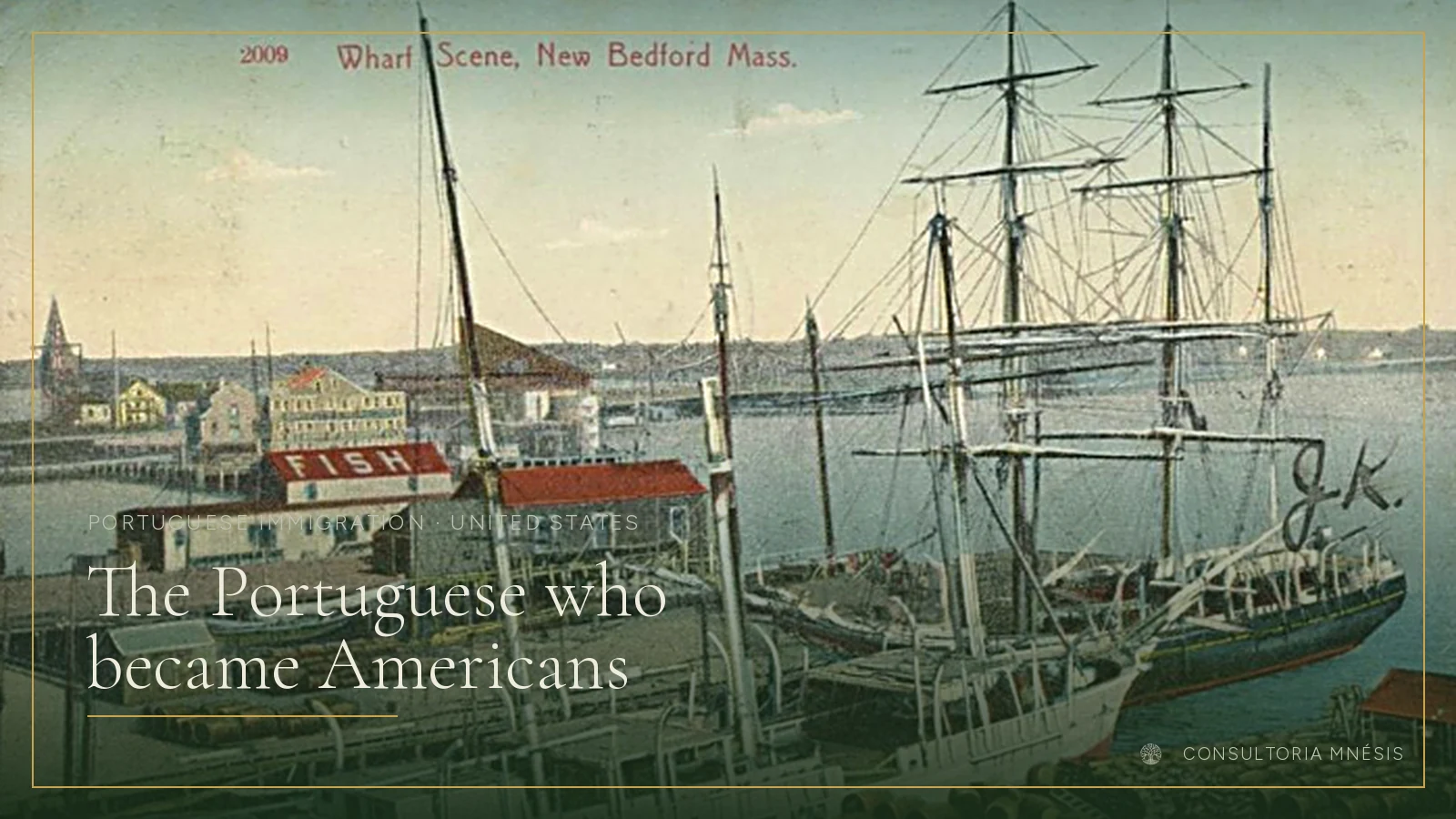
There is a city in Massachusetts where, for more than a century, Portuguese was spoken in the streets, in the mills, and in the churches. New Bedford was once the whaling capital of the world, and it was from the whaleships that the first great wave of Portuguese came to the United States. In the nineteenth century, American vessels recruited their crews in the Azores and Madeira; many of those men went ashore never to return to the sea, and sent for their families. The city filled with Azoreans. Entire communities from São Miguel re-formed, street by street, in the shadow of the textile mills.
The scale of that presence
Anyone who wishes to measure that presence needs no impressions: the numbers exist, and they are eloquent. In the passport records of the Portuguese community of New Bedford and its consular district alone, there are some eighteen thousand people. The great majority embarked between 1895 and 1930, with a clear peak just after the First World War, nearly ten thousand records in the 1920s, until the American immigration quotas of 1924 closed the door almost completely.
And the surnames that recur are the ones any descendant would recognize. The thirty most frequent in those records are, in order: Silva, Santos, Rodrigues, Ferreira, Pereira (Perry), Fernandes, Costa, Sousa, Gomes, Lopes, Alves, Oliveira (Oliver), Vieira, Almeida, Freitas, Gonçalves, Martins, Medeiros, Andrade, Teixeira, Carvalho, Dias, Pacheco, Cabral, Melo, Amaral, Pires, Souza, Duarte, and Nunes, with, in parentheses, the form the name took in English, where it can be traced. One of them, overwhelmingly Azorean, Medeiros, appears hundreds of times, revealing where most of these people came from.
A Portuguese civil registry on American soil
That community did not arrive unprotected. Portugal did what it had always done wherever the Portuguese gathered in numbers: it opened consulates. New Bedford had its own, subordinate to the Consulate-General in Boston, and its jurisdiction did not stop at the city. The documents produced there also came from Pawtucket, Wareham, Central Falls, Woonsocket, Carver, Hudson, and so many other neighboring towns; the consulate answered for an entire region of Portuguese life spread across Massachusetts, Rhode Island, and Connecticut.
And here is the point almost no one knows. That consulate was not merely a visa office: it worked as a Portuguese civil registry on American soil. There, birth, marriage, and death certificates were drawn up for Portuguese citizens; there, year after year, the children of Portuguese born on American soil were registered. In those archives lie whole boxes of applications for Portuguese citizenship for children born in the United States, and books of consular entries and certificates attesting to the nationality of every person recorded. This changes everything. A child of Portuguese parents, born in New Bedford and registered at the consulate, was Portuguese in fact, by right of blood, and the consular certificate is neither a promise nor a possibility: it is the proof. Where that record exists, there is no room for “maybe.” There is, at most, the task of finding where it lies.
And New Bedford was only one of many centers of that Portuguese life. Similar patterns appeared across the country: in California, where Azoreans were drawn by the Gold Rush and came to dominate dairy farming in the Central Valley; in Hawaii, where they landed to work the sugar plantations; in Rhode Island, said to hold the highest proportion of people of Portuguese descent of any American state; and in Connecticut, Florida, and New Jersey, where Newark earned the nickname “Little Portugal.” Each of these places had its own consulates, its own records, and its own story, which we will tell in other pages. For now, let us stay in New Bedford.
It wasn't Ellis Island
Because that is exactly where many people lose the trail. The family keeps the memory that “great-grandfather was Portuguese,” but the surname is no longer the same, and the path to the document has faded. First, an old myth must be undone.
The story goes that officials at the port renamed immigrants on arrival, by order of the authorities. As a rule, they did not. The names came already written on the passenger manifests, prepared before the vessel left Europe; officials did not routinely alter them on arrival. The change came later, and it came from within: it was the immigrant himself who, to fit into the new land, began to adapt the name. Portuguese names did not map neatly onto English spelling and pronunciation, and the surname slipped, sometimes by pronunciation, sometimes by pure translation of meaning. Rocha became Rock. Pinheiro, the pine tree, became Pine. Barros, which means clay, became Clay. Reis, which means kings, became King. Moraes became Morris, Silveira became Silver, Inácio became Enos, Oliveira became Oliver. And Pereira, the pear tree, became, with an almost perfect naturalness, Perry.
These are not stray examples. They are in the very records of those people. In that same index of eighteen thousand passports, more than four hundred people bore the surname Pereira; as many bore Rosa, which in America would become Rose. There were dozens of Rocha, of Silveira, of Pinheiro, of Barros. Each of these names is a family that crossed the ocean and, on the other side, little by little, stopped spelling itself the way it once had.
From Pereira to Perry
You may know some of these surnames without knowing where they come from. Katy Perry took her stage name from her mother's maiden name: Perry, which in origin is Pereira, of Azorean roots in Faial. Joe Perry, guitarist of Aerosmith, was born Pereira, his grandfather, from Madeira, changed the name on arrival. Steve Perry, the voice of Journey, was the son of Raymond Perry, born Pereira; his grandfather, João Pereira, became John Perry when he stepped ashore. And the songwriter Linda Perry, also of Portuguese family, grew up being told not to speak Portuguese, though her grandparents spoke it. Three or four artists, different islands, one surname that faded in the same way.
Even the most American name of all can hide a Portuguese one. Tom Hanks's maternal surname is Frager. Frager is the anglicized form of Fraga, an Azorean family from the island of Flores. In his family tree appear Rosa, which became Rose, and Inácio, which became Enos. The man who played the great heroes of the American imagination carries, in his own family name, the mark of a crossing that began in the Azores.
And this is where the story stops being about celebrities and becomes about ordinary people. Many Americans carry one of these surnames, or have heard in the family that “there was a Portuguese” a few generations back, without knowing where to begin. The documentation exists. It is only scattered: among the Portuguese archives, U.S. archives and port records, the whaleship crew lists, and above all the consular records, where in some cases every birth, every marriage, and every registration of nationality was carefully set down. To gather these threads, to retrace the path from today's Perry to yesterday's Pereira, is the work of a historian and of documentary research.
The surname changed. The bond did not. It is still there, written by hand, waiting for someone who knows where to look. If one of these names is yours, your story may well begin on the other side of the Atlantic, and it is worth investigating.
Mnésis, documentary, genealogical, and historical research. From your roots to your future.
Sources & Further Reading
The surname index cited here draws on the Portuguese consular passport records of the New Bedford district (some eighteen thousand people). The celebrity genealogies are documented in the following public sources.
- Portuguese American Journal, coverage of the Azorean ancestry of Katy Perry (Perry / Pereira, Horta, Faial) and Tom Hanks (Frager / Fraga, Flores).
- The Huffington Post, “10 Things You Didn’t Know About Katy Perry’s Family Tree.”
- Azores Genealogy (community records) and EthniCelebs, on the Pereira, Fraga, Rosa, and Enos lines of Portuguese-American public figures.
- Portuguese consular registration books of New England, parish registers of the Azores and Madeira, and U.S. passenger and passport records.