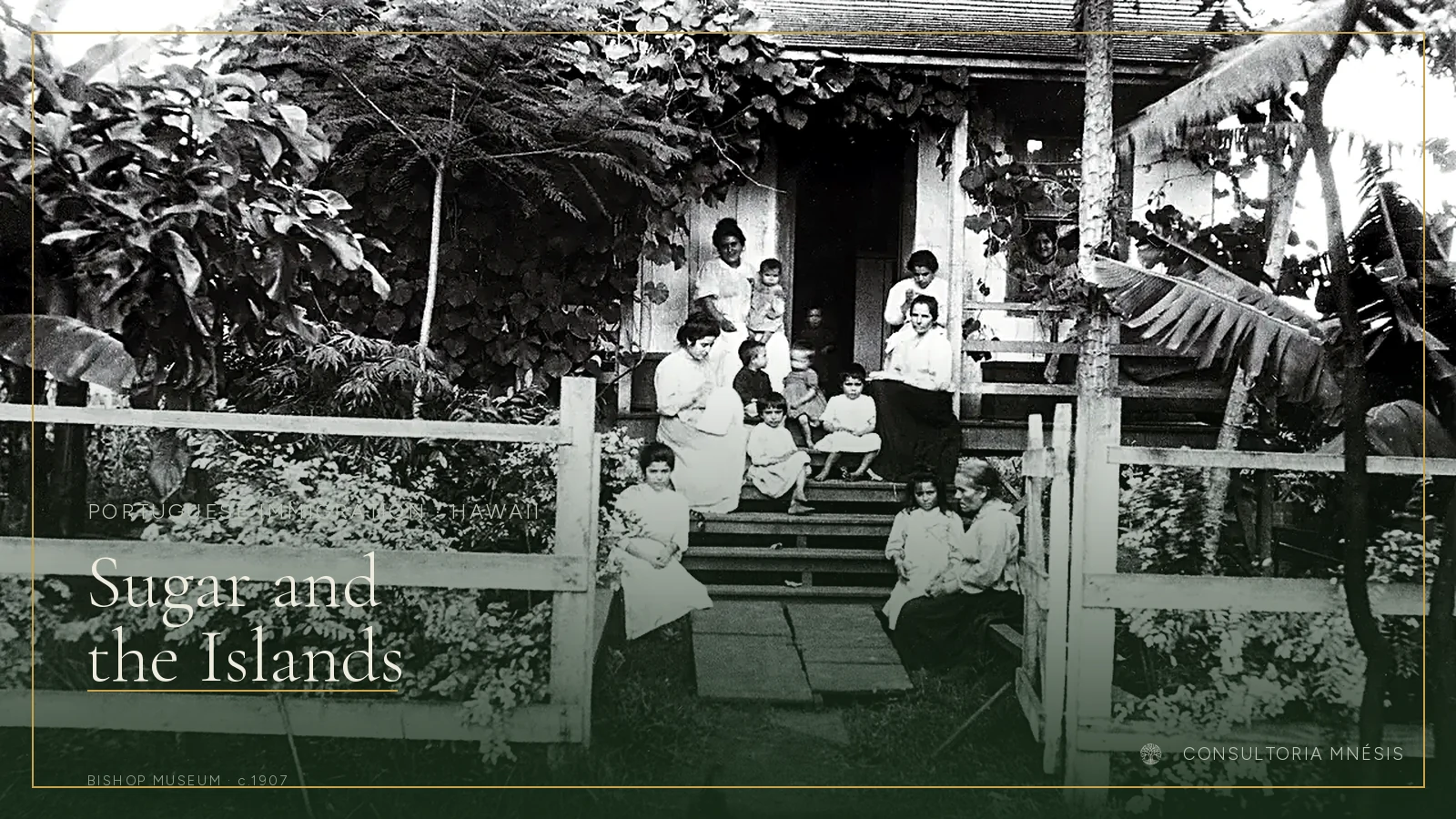
Of all the routes of Portuguese emigration to the United States, none was as long or as improbable as this one. Those who left for New Bedford crossed the Atlantic. Those who went to California rounded a continent. But those who sailed from Funchal and Ponta Delgada for Hawaii went down the whole length of the Atlantic to Cape Horn, rounded the tip of South America, and climbed the entire Pacific. It was four, five, six months at sea, with wives, children, and elderly relatives aboard, to reach an archipelago that almost no one in Portugal could place on a map. They arrived. And they stayed.
Why Hawaii needed them
To understand this migration, you have to picture what Hawaii was in the nineteenth century. It was no one's colony: it was an independent kingdom, with its own dynasty and diplomatic ties across half the world. But it was a kingdom in demographic crisis. The native Hawaiian population had been in steep decline since contact with Europeans, and at the same time the archipelago was surrendering to sugar. Cane demands one thing above all others: labor, in enormous and continuous supply. To plant, to weed, to cut, to haul, to mill.
The first contract workers came from China and Japan. But the plantation owners complained that these were single men, who served out their contracts and went home. The government of King Kalākaua wanted something else: people who would come to stay and help repopulate the islands.
It was then that two men pointed to the same place. A German botanist, William Hillebrand, had traveled through Madeira in the 1860s and been struck by how those people worked slopes that were almost vertical. And in Honolulu, a Portuguese merchant suggested to the Hawaiian government that it look for hands in Madeira, where a blight had destroyed the vineyards and plunged the island into hunger and unemployment. The name of that merchant deserves special attention, and we will come back to it.
The contracts and the ships
In November 1877 the standard contract was drawn up. The terms: 36 months of work, 26 days a month, ten hours a day. A man was paid ten American dollars a month, plus food, lodging with a small plot of land, and free medical care. Women and children earned less, under similar conditions. The passage, by far the heaviest cost of all, was paid by the Hawaiian Board of Immigration, and was only charged to the immigrant if he broke the contract.
On September 30, 1878, after three months and twenty-six days at sea, the German barque Priscilla entered the port of Honolulu with about 120 Madeirans aboard. They were mechanics, masons, carpenters, farmers. It was the beginning.
After the Priscilla came the others, year after year. The Ravenscrag, in August 1879, with 419 people after 123 days' sail from Madeira. The High Flyer, which brought the first Azoreans in 1880, and returned in 1881. The Suffolk, the Earl Dalhousie, the Monarch, the Hansa with 1,177 people, the Hankow with 1,462, the Bell Rock with 1,405, and many more. Later, under the republic and then under American rule, the Braunfels, the Kumeric, the Orteric, the Willesden, the Ascot.
In all, twenty-six ships between 1878 and 1913. Estimates range between sixteen and twenty thousand people. The gap is explained by the fact that the last voyages also carried Spaniards and mainland Portuguese, that there were stowaways aboard, and that children were born during the crossing.
The demographic impact was extraordinary. In 1878, the Hawaiian census recorded just 438 Portuguese in a population of nearly 58,000, less than 0.8%. By 1900, the Portuguese numbered around 18,000, more than 10% of the archipelago's population. In a single generation, an entire community was transplanted from two Atlantic islands to an archipelago in the Pacific.
Who they were and where they came from
This is the part that matters most to anyone searching for their ancestors today. The first ships sailed from Madeira, from Funchal and the surrounding parishes. From 1880, they began to leave the Azores as well, above all from São Miguel (Ponta Delgada) and Faial (Horta), and later from other islands. On the final voyages came mainland Portuguese too.
And they came in whole families, a great difference from other Portuguese emigrations, in which the men went ahead. That, in fact, was the very reason they were preferred. Where the contracts with Chinese workers allowed only single men, the Portuguese were permitted to bring wives, children, in-laws, brothers. You need only look at the figures of any one voyage to see it: on the Hankow in 1883, 427 men, 317 women, and 718 children arrived. In the passenger lists, children are almost always the largest group. It was not a labor force that embarked: it was a people.
The surnames that came ashore in those lists are the ones still familiar across Hawaii today, and they are where many descendants begin their search: Silva, Freitas, Medeiros, Souza, Perry (Pereira), Fernandes, Rodrigues, Gouveia, Nunes, Correia, Vieira, Cabral, Ferreira, Câmara, Botelho, Rego, Pacheco, Andrade, Machado, Teixeira, Melo, Furtado, Faria, Jardim, Abreu, Ornelas. In no other American state do the surnames Silva and Freitas reach such a concentration, the fruit, quite literally, of those plantations.
A useful warning to anyone researching: in nineteenth-century Portuguese records, it is common for children of the same couple to carry different surnames, one takes the father's, another the mother's, another a grandparent's. Anyone searching by a single surname is likely to miss part of the family. In nineteenth-century Portuguese records, this is almost the rule rather than the exception.
Where they settled
The Portuguese spread across the plantations of the four main islands: Oahu (where Honolulu lies), Maui, Kauai, and the Big Island of Hawaii. In Honolulu, the community gathered on the slopes of Punchbowl, and the streets still hold the memory: Lusitania Street, Funchal Street, Azores Street.
On the plantations and in the towns they built what they knew how to build. They raised houses and churches in volcanic stone, in the manner of the islands, when everything around them was built of wood. They founded mutual-aid societies: the Sociedade Lusitana Beneficente do Havaí, the Sociedade Portuguesa de Santo António, Court Camões, the Sociedade Madeirense, the Sociedade de São Martinho. They printed Portuguese-language newspapers in Honolulu. And they carried with them the feasts of the Holy Spirit, celebrated there to this day. The Holy Ghost church of Kula, on Maui, with its gilded altar and its Stations of the Cross marked in Portuguese, is the loveliest proof of it.
The consul named Pereira who signed Perry
Let us return to the merchant who suggested to the king that he seek people in Madeira. His name was Jacinto Pereira. He had been born on Faial, in the Azores, and had come to the Pacific as a whaler, for before the cane there was the whale, and it was the whale that first brought Azoreans to Hawaii, deserting the American ships that recruited them in the islands.
Jacinto Pereira left the sea, opened a dry-goods store in Honolulu, prospered, had a commercial building raised with the five escutcheons of Portugal carved above each door, and became the first honorary consul of Portugal in the Kingdom of Hawaii. Except that, in Hawaii, Jacinto Pereira signed his name Jason Perry.
It is the same metamorphosis we find throughout the English-speaking Portuguese diaspora, Pereira becoming Perry, as in Massachusetts, as in California. There is a certain irony in it: the man officially representing Portugal was already using the anglicized version of his own Portuguese name. And a son of his, Antonio Perry, would become Chief Justice of the Supreme Court of Hawaii in the 1920s and 1930s. From the son of an Azorean whaler to the territory's highest magistrate, in two generations.
From 1882, Portugal and Hawaii signed a Provisional Convention, and Portugal established a permanent consulate in Honolulu. The first consul-general, António de Sousa Canavarro, oversaw compliance with the contracts, inspected the housing and the sanitary conditions, and sent reports back to Lisbon on the life of those people. That consulate produced documentation, and it is, today, part of the way back.
What they left behind
Work in the cane was a means, not an end. Once their contracts ended, many left the plantations: they became mechanics, carpenters, blacksmiths, small farmers, shopkeepers in the towns. Others went on to California. Few returned to the Atlantic islands.
The legacy stayed. The kitchen stayed, the linguiça, the chouriço, the carne de vinha-d'alhos, the sweet bread, the malasadas, all part of everyday Hawaiian life today. The word paniolo stayed, still used for Hawaii's cowboys. The feasts of the Holy Spirit stayed.
And, above all, a small four-stringed instrument stayed. It was called the machete or braguinha in Madeira, the cavaquinho in the Azores. It came aboard the Ravenscrag in 1879, and was played on the Honolulu dock the night they arrived. Three Madeiran carpenters aboard that ship, Manuel Nunes, Augusto Dias, and José do Espírito Santo, began to make it in the islands. King Kalākaua loved the sound. The instrument changed its name and became the sonic symbol of Hawaii: the ukulele. Manuel Nunes lies buried in the Catholic cemetery on King Street, in Honolulu.
The way back
Today, more than four percent of Hawaii's population claims Portuguese descent. Five, six generations have passed. Many married outside the community, and the language has been all but lost. The descendants kept their names and surnames, which still stand for a strong emotional tie, but gradually cut the roots that bound them to the Old World.
And that is where the trail often breaks. You know your great-grandfather came from the islands. You do not know which one, nor from what parish, nor on what ship, nor in what year.
But that information exists. The passenger lists of the twenty-six ships exist. The plantation records exist, with the name and contract number of each worker. The parish books of Hawaii's Catholic churches exist, the cemeteries, the Portuguese newspapers of Honolulu, the archives of the mutual-aid societies. The records of the Portuguese consulate in Honolulu exist, and the correspondence that went from there to Lisbon. And on the other side of the world, the parish and civil records of Madeira and the Azores are still there: baptisms, marriages, deaths, passports, and emigration permits, parish by parish.
The work is to join the two ends: the surname of today, in Hawaii, to the baptismal entry in a parish in Câmara de Lobos, Ponta Delgada, Horta, or Santana. It is documentary research, carried out in the archives of two continents, and it is precisely what we do at Mnésis.
If your family reached Hawaii on one of those ships, if at home it was said that your great-grandparents came from Madeira or the Azores for the cane, that crossing was recorded. Someone wrote their name in a book, a hundred-odd years ago, and that crossing often left a record. It remains to go and find it.
Mnésis, documentary, genealogical, and historical research. From your roots to your future.
Sources & Further Reading
- Passenger manifests of the emigrant voyages from Madeira and the Azores to Honolulu (1878 onward), including the vessels named in this article.
- Portuguese consular registration records for Hawaii, which functioned as civil registers for Portuguese nationals abroad.
- Parish baptismal and marriage registers of Madeira and the Azores (Câmara de Lobos, Ponta Delgada, Horta, Santana, and others).
- Passport application registers of the Portuguese districts of emigration.