When the client came to me, the entire family believed itself to be of German origin. And it was not a foolish mistake. There was the Germanic surname, the Paraná plateau with its German settlements, and entire generations that had married within that world. Everything on the surface pointed to Germany. But as I went through the documents, one name made me stop. Among so many Germanic surnames, in an old generation, there appeared a woman named Narciza.
Narciza was not a name one would expect in that German-speaking world. It is rooted in the Latin Catholic calendar of saints, common among Portuguese, Italians, Spaniards, and Brazilians, and markedly unusual in the naming repertoire of that German community, where one would expect Wilhelmine, Bertha, Auguste, Frieda. A Narciza surrounded by German surnames was a dissonance. And dissonance, to anyone in this craft, is the loose thread you pull. She might simply have been a Brazilian-born woman who married into a German family and took her husband's surname, a reasonable hypothesis. But the strangeness called for a test, and the test dismantled the certainty of the entire family.
Narciza was not German. She was the daughter of Italians. But proving it was harder than suspecting it, and the path to proving it is the most instructive part of this story.
Several documents pointed to the same place. The family really was in Morretes, and documents of her siblings pointed to that locality as well. I had, therefore, the correct town. So I asked the diocesan archive for Narciza's baptism, but with a problem at the root: none of her records stated her year of birth with certainty. The date survived only indirectly, in the parents' details recorded on their children's marriage records, and so I asked the archive to search a broad window of nearly a decade, knowing from experience that declared ages often diverge from actual ages. The answer came back negative. The parish could not find her.
A negative result is a difficult moment. Not because it proves us wrong, but because, by itself, it proves almost nothing. The archive simply falls silent. And the historian faces the same old doubt: did I miscalculate, or does the document not exist? I knew the town was correct; the other records supported that conclusion. What remained was to find Narciza within that place and its records.
That was when I changed the strategy. Instead of insisting on her, I went to the parents. If the daughter would not open the way, I would work through the generation above her. I had already found the father, Antonio, single, in a colonial record of 1879, which narrowed the window for the marriage. Using the mother's likely age and the birth of another child I had already located, I narrowed the probable date of the marriage and asked the diocese to search for it. And the marriage appeared. With it in hand, I could work backward from the marriage, count back through the likely first pregnancy, and ask the archive to look again, now in a narrower and surer window. On the second search, Narciza was there.
The baptism resolved the question. It fixed the birth on 28 October 1883, a date that, as I suspected, no document of hers had ever declared directly. When she married in 1901, Narciza gave her age as eighteen, when she had not yet turned it. We do not know why; ages recorded on paper often diverged from actual ages. It was the baptism, performed before the priest when she was an infant, that preserved the date that later records had rounded off.
The lesson holds. A negative from an archive is not a dead end; it is an invitation to enter by another door. When a person's own document refuses to appear, it is often the records of the people around them, the parents, the siblings, the cousins, that point the way back. Narciza would not let herself be found head-on. She had to be found from the margins.
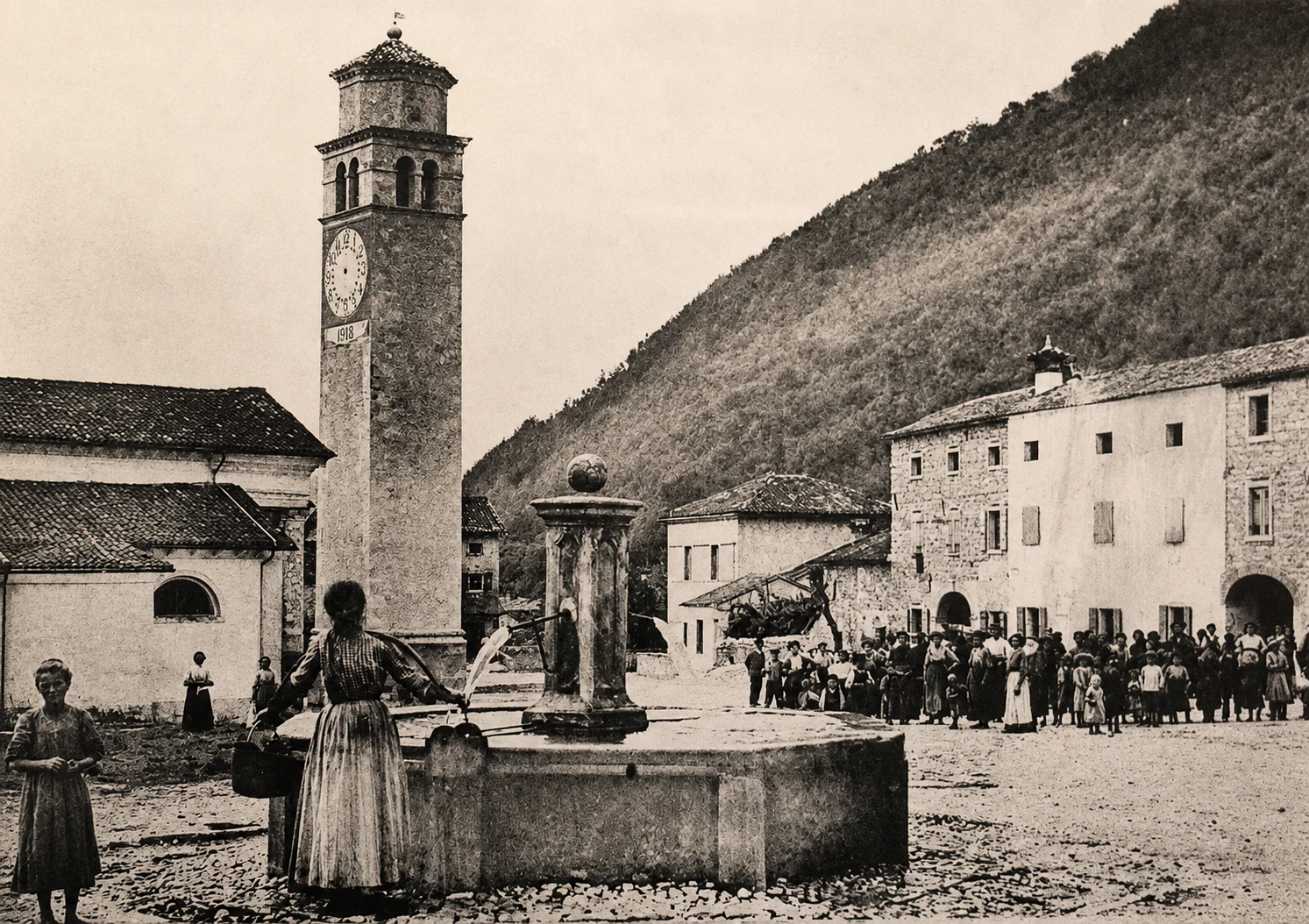
Her parents came from the Veneto. Her father, Antonio Paolo Cecchinel Colet, had been born in Tovena, a small locality in the comune of Cison di Valmarino, in the province of Treviso, in 1856, in a region that, at the time, was not yet part of Italy; it belonged to the Austrian Empire and would only pass to the Kingdom of Italy in 1866. Her mother, Ambrozia Antoniazzi, had come to Brazil as a girl, in the wave of Veneto migration that arrived in Paranaguá in 1877 and was settled at the Nova Itália colony, in Morretes. Antonio and Ambrozia married there, in Morretes, in August 1883, and Narciza was born that same year. The mother was herself little more than an adolescent, and already expecting her first child, a situation also found in nineteenth-century Catholic rural records. Narciza was the first generation of the lineage born on Brazilian soil.
It is worth opening a window here onto the colony, because it explains a great deal. Nova Itália was, in its origin, a strongly Italian settlement, the province's second major official colonization initiative involving immigrants from the Veneto, created to receive settlers displaced from an earlier colony that had failed. More than eight hundred Italian immigrants. But the Paraná around it was not Italian; it was a mosaic. Even among the few families occupying that old estate before the Veneto arrived there was a German family. And when later generations began moving up the Serra do Mar toward the plateau, to Campo Largo and Curitiba, they entered a densely Germanic region, sown with mixed colonies. The family was not born among the Germans. It went to meet them.
And that is exactly what happened to Narciza. In 1901, at seventeen, she left the coast and married Frederico Büsemeyer, a surname of clear Germanic formation, in Campo Largo, on the plateau. From that marriage on, her Italian origin began to disappear. And here lies the heart of this story, the point that matters more than any family tree.
You cannot always have both sides.
In the naming pattern this family followed, the father's surname continued to the next generation, while the mother's, save for exceptions, did not. Where the Iberians often composed a child's name from the father's surname and the mother's, leaving the maternal line inscribed and visible for generations, in the family and German community Narciza entered the children carried only the paternal surname. The result was immediate. The son of that marriage, Guilherme, born in 1902, appears in the records simply as Busmayer. In a single generation, the mother's Italian surname evaporated. There was no carelessness, no failure of affection. It was the very grammar of the name that erased Italy, in one leap. The surname preserved the paternal line, while the maternal line was left largely to oral memory, which is fragile and degrades quickly. To the grandchildren, Narciza was already just one more German among Germans. The only trait that resisted the erasure was her first name, that stubborn, Latin Narciza, the last witness to her own origin.
There is a second phenomenon this case shows with rare clarity, and it can be seen in the names of her parents. When the Italians were registered in Brazil, civil and parish record-keepers wrote down what they heard. In the 1883 marriage, Cecchinel Colet was recorded as Sechineli. Antoniazzi became Antoniaci. Domenica, the grandmother, was registered as Masota Dominica. The clerk was not falsifying anything; he was recording the name phonetically, adapting the foreign name to the language of the land. And that process did not stop at arrival. Looking at the family's collateral branches, the descendants of Narciza's siblings, I found that same Antoniaci already transformed, two generations later, into Antonino in one branch, into Antonio in another. The Italian surname did not simply change on arrival; it kept sliding from generation to generation, each new record drawing it closer to forms that sounded more familiar to the writer, until the family name eventually dissolved into what looked like an ordinary Brazilian given name.
That is why a case like this is not solved by looking only at the straight line. The research had to move sideways, to the cousins, the siblings, the branches no one asked about, and it was that lateral research that confirmed what Narciza's name had been whispering from the start. A historian who confined himself to the surname could have filed Narciza away as German and never found Tovena.
In the end, it was a baptismal name that brought the family back to the Veneto. Narciza crossed three generations disguised as a German, and it took only noticing that her name did not match the rest to undo the disguise. The origin had been there all along, kept not in a solemn document but in the stubbornness of a first name no one thought to change.