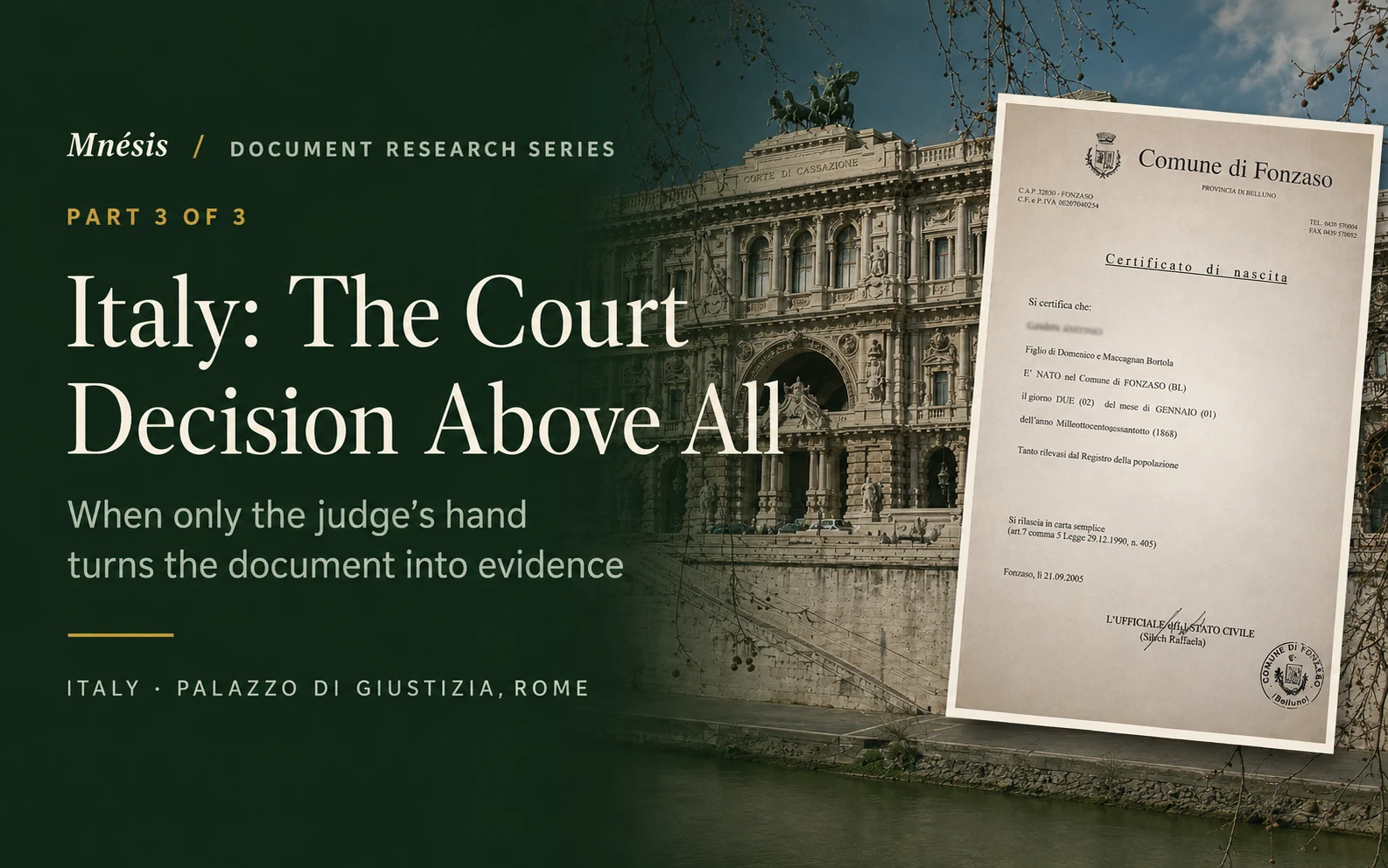
In the article on Spain, I closed with a promise. Italy also accepts the reconstruction of records from corroborating evidence, it too trusts that mechanism to separate the legitimate case from the fraudulent one, but it has a particularity that changes everything. In Italy, reconstruction is always judicial. It is the judge's decision above all else. And to understand why, you have to understand how the Italian citizenship process itself was built.
The most sought-after citizenship, and the queue that created the courts
Italian citizenship by descent is among the most sought-after citizenship routes in the world, and one of the most requested in Brazil. It is no accident: the number of Italians who settled here was immense, and the genealogical complexity of these cases is enormous.
For a long time, applications were made through the consulate. And the volume was so large that a queue formed, a real queue, in which people waited ten, fifteen, sometimes twenty years to be seen. It was in the face of that absurdity that the mechanism which defines the Italian process to this day was born: the judicial route. Firms began filing actions against the Italian State challenging the excessive delays, on a simple, strong argument: that the right to citizenship cannot be curtailed by a delay of that magnitude. A wave of lawsuits followed. Whole families, ten, twelve people at once, filed together. And for a long time, especially in Brazil, it was through the courts that most Italian citizenships were secured.
What changed: the end of descent without limit
Until 2025, Italy had one of the broadest citizenship-by-descent regimes. There was no generational limit. You could descend from an Italian great-grandfather, great-great-grandfather, or great-great-great-grandfather, and, as long as you proved the unbroken line of jus sanguinis, you had the right. That is what allowed those family cases with ten or twelve applicants at once.
That ended. On 28 March 2025, the Italian government issued Decree-Law 36/2025, known as the Tajani decree, later converted into Law 74/2025, which inserted Article 3-bis into the old Citizenship Law, Law 91 of 1992. The new rule is restrictive: automatic recognition now generally reaches only as far as the grandparent. Whoever has an Italian parent or grandparent still qualifies. Whoever descends from a great-grandparent or further back, as a rule, no longer enters through this door. And the cut-off was by date: anyone who had already filed the application or the court action by 27 March 2025 remains under the old rule; anyone who arrived after falls under the new one.
Here is the current impasse. This law is being challenged in the courts. Its compatibility with the Italian Constitution and with European Union law has become a matter of dispute, and the question has reached the Court of Justice of the European Union, in Luxembourg. In other words, even the law that restricted citizenship is itself being judged. Judicially. Which only confirms this article's thesis: in Italy, everything, in the end, passes through the judge.
Keeping that point in mind matters, because it explains the current climate. But the heart of this article is not the law that restricted who can apply. It is what Italy requires of the document from those who still can.
The Italian ancestor's record and the descendant's record
Here two things have to be separated, because they follow different logics.
First, the document of the Italian ancestor, the immigrant. That is the base document of any citizenship case. And in the Italian case it is generous: both the civil record and the baptism count, one or the other. The Italian civil registry, the stato civile, is very old, so for many years the two documents coexist, and either one serves to prove the ancestor. Italy did have documentary losses, as every country did. But its registry is old enough that, in most cases, the Italian's document exists and is accepted directly.
The problem appears on the other side of the line, with the descendants, here in Brazil. When I locate, along the chain, a descendant's baptismal record drawn up after Brazilian civil registration already existed, and I cannot find that person's civil record, that baptism has no immediate validity. It does not replace the birth record, just as it did not in Portugal. Except that, unlike Portugal, here there is a way out. And that way has a mandatory path: it goes through the judge.
When reconstruction requires a judge
This is the point that defines Italy, and sets it apart from Spain.
That descendant's baptism, drawn up late, is not valid on its own. It becomes raw material. To have effect in the process, it must be used inside a court action that reconstructs, or rather, that orders the drawing up of, a birth record for that person. It is the judge, by decision, who turns the baptism into a valid civil document. And when there is neither baptism nor birth record, but there are corroborating documents proving the parentage and the line, the path is exactly the same: the action is filed, and it is the judicial decision that reconstructs the record from those documents.
Note the fine difference, because it is the close of the series. Italy does not validate a late baptism the way one stamps a paper. It offers a mechanism, the judicial route, that lets a record be created or reconstructed from corroborating evidence, and it is that reconstruction, born of the judge's decision, that comes to have validity in the cases running through the Italian courts. The Italian system places the judiciary at the center of the reconstruction process. The document, alone, decides nothing. The one who decides is the judge.
The same proof, three different answers
We reach the end of the series, and now the whole design comes into view. Take a single case, the most common of all: a descendant who has only a baptism drawn up after civil registration already existed, or only corroborating documents, and no birth record. The same situation. The same proof. And three completely different answers, depending on the country.
Portugal
The conservatória accepts reconstruction only when it rests on an original document, and refuses a reconstruction built from corroborating evidence.
Spain
Out-of-term registration and the baptism with a certificate of no record. Reconstruction from corroborating evidence is accepted, often over the counter.
Italy
Reconstruction exists and is accepted, but it is always born of a judicial decision. The judge turns the document into legal proof.
In Portugal, the answer is no. The conservatória, the Portuguese civil registry office, accepts reconstruction only when it rests on an original document, and refuses a reconstruction built from corroborating documents. The door stays shut.
In Spain, the answer is yes, and often over the counter. The country that lost so many records in the Civil War built instruments to reconstruct from corroborating evidence, the out-of-term registration, the baptism with a certificate of no record, and accepted that the same be done abroad. The door opens through the registry.
In Italy, the answer is also yes, but only by the judge's hand. The reconstruction exists, is accepted, has validity, but it is always born of a judicial decision. The door opens in court.
The same document, three countries, three answers. Not because one is more just than another, but because each carries its own history, its own loss, and its own way of trusting, or distrusting, what time left in the archives. Understanding which door it is, and where it opens, is the difference between a process that moves and one that dies at the first requirement.
And it is exactly that map, knowing where the document is, which document to use, and by which path it gains validity in each country, that we know and walk, every day, at Mnésis.
From your roots to your future.