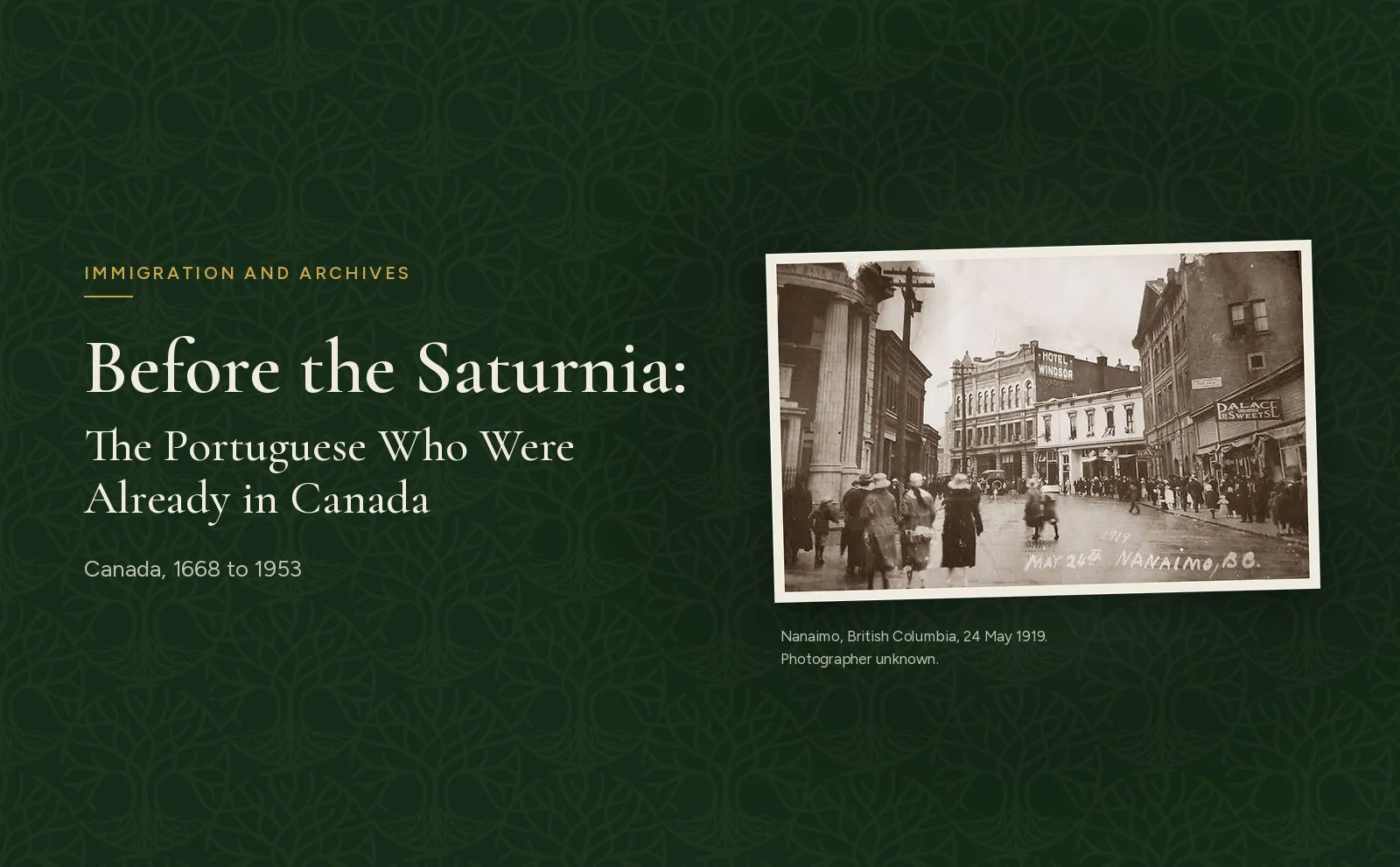
On 14 May 1953, 69 Portuguese workers landed at Halifax from the liner Saturnia. They are celebrated today as the pioneers of Portuguese immigration to Canada, and rightly so: mass emigration began with them. The Portuguese presence in the country is much older.
Consultoria Mnésis examined eleven Canadian censuses taken between 1851 and 1931 and found people born in Portugal in every one of them.1 They were few: five records in 1851, forty in 1901, and between 33 and 35 in the censuses of 1911, 1921 and 1931. They were scattered from Quebec to the Yukon, with no organized community life. The records they left show how the history of a migration depends on the terms under which people left home.
Pedro da Silva and the Families of New France
The Portuguese presence predates the censuses. According to The Canadian Encyclopedia, the Portuguese of New France descended from a few families founded by immigrants who arrived from 1668 onward. In five centuries of contact, only a handful of Portuguese fishermen settled on the Atlantic coast.2
Luso-Canadian historiography remembers one name from that period. Domingos Marques and Manuela Marujo record that Canada's first mail service was carried out in 1693 by a Portuguese man living in Quebec, Pedro da Silva, who carried a packet of letters from Montreal to Quebec City.3
The cod fishery brought Portuguese crews to the coasts of Newfoundland for centuries, but that is another story. The fleet came and went with each season, and Newfoundland only became part of Canada in 1949.
Alves, Maunders and Teresa Gallagher: Isolated Lives in Central Canada
In the censuses of 1851, 1861 and 1871, most of the people born in Portugal whom we identified lived in present-day Quebec and Ontario. One of them appears three times in Montreal, transcribed as Alvis in 1851, Alvez in 1861 and Alves in 1871. Everything points to the same man, Francis J. Alves, whose declared ages place his birth around 1795.
In the same city, Joseph Maunders gave his age as 95 in 1871 and 101 in 1881. His English name does not tell us whether he was Portuguese or a Briton born in Portugal. The censuses make no such distinction, and the same doubt hangs over dozens of records from the period.
Kingston offers the case best documented in the press. Teresa Gallagher died in the city on 4 March 1869, aged 69, a native of Portugal who had lived in Kingston for thirty years, according to the notice published in the Daily British Whig.4 She had therefore arrived around 1839.
In Portuguese tradition, the great majority of women did not take their husband's surname. In the Canadian record, Teresa exists only under his, and the name she was born with disappears. Nor does she appear as born in Portugal in the census transcriptions we examined. Hers is the first of several absences that oblige us to read these figures as a floor, not a count.
From the Gold Rush to the Klondike: Joe Silvey, Maciel and Flores
From 1881 onward, the centre of gravity shifts to the Pacific. In that year's census, half of the records we identified are in British Columbia. In 1901, counting the Yukon, the West accounts for 25 of the 40.
The route ran by sea and by gold. According to historian Jean Barman's biography, Joe Silvey, a native of the island of Pico, reached the British Columbia coast around 1860 aboard a whaler and jumped ship to try his luck in the mines.5
Inland, two men run through three censuses in the Yale district: John Maciel, transcribed as McCelle, Masciel and Marciell, and Joaquim Flores, transcribed as Floris and Florence. Their declared ages in 1881, 1901 and 1911 indicate that these are the same people.
At Englishman's River, on Vancouver Island, John Sousa died in hospital on 26 March 1905, aged 92, a native of Portugal who had lived there for forty years.6 Like Teresa Gallagher, he does not appear under that name in the census transcriptions.
Yukon gold took others further still. In 1901 the census records seven men in the territory with Portuguese or Portuguese-looking surnames: Costa, Pires, Rosa, Enos, and transcribed forms that appear to be Gomes, Lopes and Botelho. In 1911 there is a Furtado in Dawson, a Manuel Botelho at Quartz Creek and a Joseph Enos on Hunker Road.
John Enos, from the Azores to Nanoose
John Enos, a native of the Azores, is the most complete case we were able to assemble. On 26 September 1864 he pre-empted Lot 7 in the Nanoose District on Vancouver Island, and nearby Enos Lake still bears his name.7 Five weeks later, a Victoria newspaper was already describing him as a settler at Nanoose Bay with a potato crop to be dug.8
In 1871 a correspondent writing from Nanaimo described the farms of Enos and of one Bonnell at Nanoose as splendid, and urged the government to open the Comox road so that livestock and ox teams could get through.9 In May 1877 Enos was working at the Chase River mine, where he fell on a lump of coal, dislocating his elbow and breaking a bone in his forearm.10 The 1881 census records him at Nanaimo and Nanoose, aged 46.
In November 1889 he placed a notice in the paper asking his debtors to settle their accounts, and anyone with claims against him to present them, by 15 December.11 In May 1890 he bought the ranch of R. Parkinson, the village shoemaker at Alberni.12 That August the Nanaimo paper announced that Enos was leaving for the Azores, his native land, to see his childhood home again. It called him one of the most enterprising settlers of Nanoose and said that by industry and perseverance he had earned a competence in the land of his adoption.13 He returned in July 1892, described now as a man who until recently had been a successful farmer at Nanoose and, according to the paper, in better health and with greater vigour.14
In February 1894 Enos wrote to the Nanaimo municipal council that the new city map had taken away the water access he had enjoyed for 33 years at his lot on Fraser Street.15 In 1899 the Deputy Minister of Marine forwarded to the council a letter from Enos, printed in full in the press, in which he told his own story. In 1860, with the leave of the Hudson's Bay Company, he had taken up land beside the Commercial Inlet, which he reached by boat and used that way until 1892. He had later signed a deed from the New Vancouver Coal Company that cut off his waterfront, unable to read English and with no one to explain the document to him. He described himself as a native of Portugal and a naturalized British subject of many years' standing. The council filed the letter.16
Brockton Point, 1888: The House of Joe the Portuguese
There were also small clusters. At Brockton Point, on the peninsula that would become Vancouver's Stanley Park, Indigenous, Portuguese and other families had lived since the 1860s without title to the land.17
In December 1888 the site was under quarantine. The municipal committee report published on the 18th lifted the quarantine for everyone except "Joe, the Portuguese" and his family, who were to remain under guard for ten more days. In the same clause, it instructed the police to notify all the squatters at Brockton Point to leave, because of the great danger of infection, and to burn every building when the notice expired.18
In January 1889 the Board of Health considered the claim of "Portuguese Joe" for the property burned during the quarantine. Without admitting any legal liability, it offered him 150 dollars in full satisfaction.19
Decades later, city archivist J. S. Matthews recorded that the medical health officer had recommended destroying the houses for fear of smallpox. He also noted, without investigating it, a report that a lawsuit had forced the city to rebuild them.20 The press of January 1889 shows how the claim that reached the board ended: in a settlement. That does not rule out a lawsuit. Nor do the documents say which of the Portuguese men known by that nickname was the Joe of Brockton Point.
Pictou, Hantsport and Saint John: The Portuguese of the Atlantic
On the Atlantic coast, the censuses show men who stayed in the same place for decades. In Pictou, Nova Scotia, John Silva and Manuel Silva appear from 1881 to 1911, and John again in 1921, recorded as Silvia. In Hants County, Francis Silver, probably an English form of Silva, and Joseph Fritz are at Falmouth in 1871 and at Hantsport until 1901. On Cape Breton, a Joseph Neves passes through the censuses of 1901, 1911 and 1921, transcribed as Naves, Nares and Knaves. In New Brunswick, Joseph Roderick, very likely Rodrigues, lives in and around Saint John from 1881 to 1921.
These names help us read a figure from the 1921 census. That year Nova Scotia had 167 people classified as of Portuguese origin, the largest concentration in the country. Of these, 153 had been born in Canada.21 They were not immigrants. The simplest hypothesis is that at least some of them descended from men like those of Pictou and Hantsport. The published census cannot place them: in the county tables, the Portuguese are counted together with other European origins. Proving it means opening the households one by one.
Montreal, Halifax and Quebec City: The Corridor to New England
Not every Portuguese traveller who passed through Canada meant to stay. On 18 August 1886, forty Portuguese immigrants arrived from Boston at Bonaventure station in Montreal, bound for Chicago and the western states.22
Two years later, Canada served as a detour. In August 1888 the Portuguese brigantine Neptune put into Halifax from Faial, in the Azores, bound for Boston with some sixty Portuguese women on board: 58 according to the Manitoba Free Press, fifty-six according to The Washington Post, which ran the story under the headline Portuguese Immigrants via Canada.
The vessel was said to have called for water. It later emerged that the purpose was to land the women and send them on by rail, getting around American law, because they had already been engaged, in the words of the dispatches, "to enter service in the United States."23 The newspapers' explanation calls for caution: the American law of 1885 against the importation of contract labour expressly exempted persons employed strictly as personal or domestic servants.24
In Saint John, the Daily Telegraph recorded the arrival, on 24 August, of about fifty Portuguese immigrants from Halifax, who went on by boat to Boston. It gave the western states as their final destination and said they had reached Halifax aboard the Thingvalla, a Danish liner then in port after a much-reported collision.25 They were probably the women of the Neptune, but none of the papers says so.
By 1913 the corridor appears at scale. In the lists of passengers landed at Quebec City that year, there are whole pages of people born in Portugal, classified as Portuguese, with the same entry where their intended occupation in Canada should be: in transit to the United States.26 The destinations are New Bedford, Fall River, Taunton, Lowell, Boston, Providence, New York and, in California, Oakland. The trades are workman and servant. Several names carry the stamp DETAINED.
In the pre-1922 lists we examined, most people born in Portugal belong to these 1913 contingents. Counting them as immigrants to Canada would be a mistake. Canada was the door, not the destination.
What the 1921 Census Counted
The clearest statistical portrait of the period comes from the 1921 census. It asked each person for their "racial or tribal origin" and did not accept "Canadian" as an answer. It sought to establish the ethnic stocks from which the population descended, and it recorded that information separately from place of birth.27
Across Canada, 467 people were classified as of Portuguese origin. Nova Scotia had 167; British Columbia, 106; Quebec, 51; Ontario, 47; Alberta, 44; New Brunswick, 35; Manitoba, 13; Saskatchewan and the Yukon, two each. Prince Edward Island and the Northwest Territories recorded none.28
Setting origin against place of birth changes how that figure reads. Of the 467 people, 340 had been born in Canada and 34 in the United States. That leaves at most 93 born in Portugal or anywhere else.28 In 1921 the Portuguese presence in Canada was above all a matter of lineage, not of recent immigration.
The figure itself was new. In the comparative tables published with that census, the Portuguese of 1901 and 1911 still appear lumped together with other small origins, such as Spanish, Maltese and Brazilian.29
New arrivals remained minimal. Between 1926 and 1935, immigration statistics classified 118 newcomers as Portuguese: 28 in the peak year, 1929, and between five and nine a year from 1931 to 1935.30
Why There Is So Little Paper
The records of this period have a shape of their own, and that shape follows from the way these people left Portugal. There was no state recruitment, no collective contract, no train waiting at the wharf. There were whalers who jumped ship, prospectors, fishermen and passengers in transit. Even at sea their presence was rare: in the fiscal year ending June 1887, Halifax customs recorded the arrival of a single Portuguese-flagged vessel, of 192 tons with a crew of eight.31
This individual movement generated almost no paper of departure or arrival. It generated paper of settlement: Enos's pre-emption and his declared naturalization, a municipal minute, a 150-dollar settlement, an obituary, a line in a census. Transit, by contrast, left complete lists, because it passed through a Canadian inspection.
That paper is hard to read. English names hide people: Silver, Roderick, and even a Peter Smith born in Portugal whom the 1901 census records in Vancouver. Transcriptions go wrong: in one of them, 43 French-Canadian residents of the parish of Portneuf, Quebec, appear in 1921 linked to Portugal, most likely through confusion between the two words. And some people are simply missing, like Teresa Gallagher and John Sousa.
When the Saturnia tied up at Halifax in May 1953, the Portuguese on board were arriving within a system that produced paper at every stage, on both sides of the Atlantic: public notice, registration, contract, embarkation list, a train waiting at the wharf. The 69 were not Canada's first Portuguese. They were the first to arrive through an organized migration with Canada as its destination.
At Consultoria Mnésis
At Consultoria Mnésis, we research the lives of Portuguese people and their descendants in Canada, before and after 1953, cross-referencing censuses, passenger lists, newspapers and Portuguese records.
Sources
- Consultoria Mnésis, own survey of people born in Portugal in the censuses of Canada, 1851 to 1931, 2026.
- The Canadian Encyclopedia, entry on Portuguese Canadians.
- Domingos Marques and Manuela Marujo, With Hardened Hands: A Pictorial History of Portuguese Immigration to Canada in the 1950s, preface.
- The Daily British Whig, Kingston, 9 March 1869, p. 2.
- Jean Barman, The Remarkable Adventures of Portuguese Joe Silvey. Madeira Park: Harbour Publishing, 2004.
- The Nanaimo Free Press, 27 March 1905, p. 4.
- BC Geographical Names, entry for Enos Lake. Government of British Columbia.
- Victoria Daily Chronicle, 1 November 1864, p. 2.
- Victoria Daily Standard, 11 November 1871, p. 3.
- The Nanaimo Free Press, 30 May 1877, p. 3.
- The Nanaimo Free Press, 15 November 1889, p. 4.
- The Victoria Daily Times, 15 May 1890, p. 8.
- The Nanaimo Free Press, 12 August 1890, p. 3.
- The Nanaimo Free Press, 6 July 1892, p. 3.
- The Nanaimo Free Press, 14 February 1894, p. 1.
- The Nanaimo Free Press, 2 May 1899, p. 1.
- The Canadian Encyclopedia, Vancouver Feature: Squatters Settle in Stanley Park.
- Daily News-Advertiser, Vancouver, 18 December 1888, p. 8; Vancouver Daily World, 18 December 1888, p. 1.
- Vancouver Daily World, 15 January 1889, p. 4.
- J. S. Matthews, Early Vancouver, vol. 3.
- Dominion Bureau of Statistics, Sixth Census of Canada, 1921, vol. I. Ottawa, 1924, table 24, p. 356; table 27, note on p. 384; table 29, p. 560.
- The Gazette, Montreal, 19 August 1886, p. 3.
- Manitoba Free Press, Winnipeg, 30 August 1888, p. 1; The Washington Post, 30 August 1888, p. 2.
- United States, Act of 26 February 1885 prohibiting the importation and migration of foreigners and aliens under contract or agreement to perform labor, 23 Stat. 332, section 5.
- The Daily Telegraph, Saint John, 25 August 1888, p. 3.
- Lists of passengers landed at Quebec City, 1913. Primary documentation located by Consultoria Mnésis.
- Dominion Bureau of Statistics, Sixth Census of Canada, 1921, vol. I. Ottawa, 1924, introduction, pp. xiv and xv.
- Ibid., table 24, pp. 356 and 357; table 29, p. 560; table 30, p. 564.
- Ibid., table 22, p. 353.
- Dominion Bureau of Statistics, Canada Year Book, 1937, table Racial origins of immigrants into Canada, calendar years 1926 to 1935.
- The Halifax Herald, 26 October 1887, p. 1.