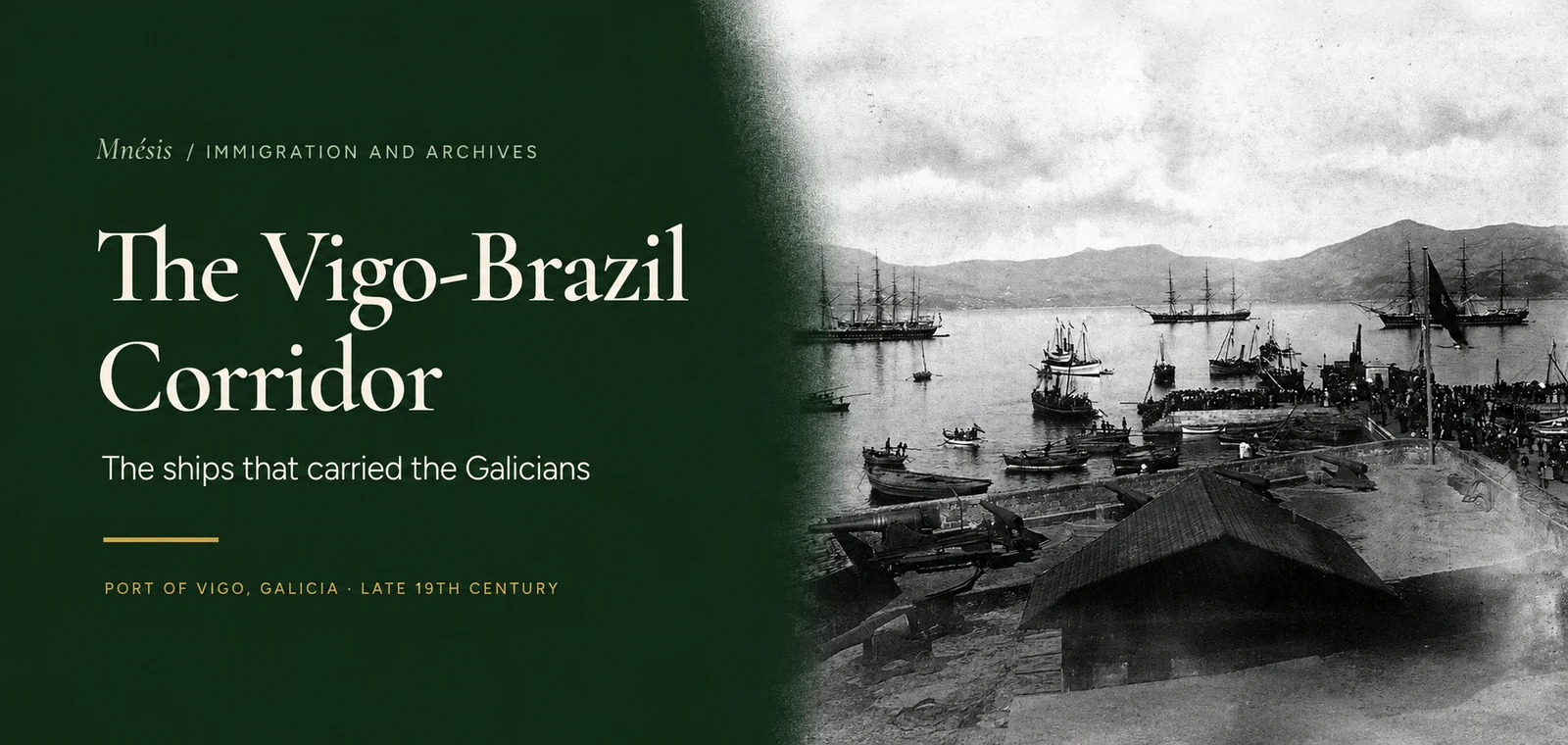
In the late nineteenth century, thousands of Galicians left the ports of Vigo and A Coruña bound for Brazil. Many of their descendants today possess only the name of a ship, preserved on a family document or passenger list, without knowing what that name means. This article maps those routes and those steamers, so that the ship's name may speak again. It is the documentary companion to an earlier text, “What a Passenger List Does Not Say”, where we dealt with how to interpret the source; here we gather the companies, the routes and the actual ships that linked Galicia to Brazil.
A Corridor of Departure and Its Scale
Galician emigration to the Americas was concentrated through a limited number of ports. Above all, Vigo and A Coruña served as the principal departure points of the northwestern Iberian Peninsula. The scale of that flow is considerable: documentation based on Brazilian reports indicates 8,227 departures from Vigo bound for Brazil in the years 1896 to 1899 alone, distributed as 2,788 in 1896, 2,476 in 1897, 1,800 in 1898 and 1,163 in 1899.¹ That is four years only, and from a single port.
One point should be made clear from the outset, because it runs against common intuition. The large ships that carried these migrants were rarely Spanish or Portuguese. The largest companies on the South American route were English and German. A survey of the South American market of the period counts, on the line, seven British companies, three French, three Italian, two German and only one Spanish.² The ships that carried Galician emigrants to Brazil were, in the overwhelming majority of cases, foreign-flagged. English and German shipping companies are therefore among the first places to look when reconstructing an ancestor's voyage.
The Companies and Their Steamers
The first company to consider is the Royal Mail Steam Packet Company, known in Brazil as the Mala Real Inglesa. Vigo was a regular stop on its South American route: as early as 1880 there was an official schedule for the mail steamers coming from Southampton to call at Vigo on regular dates. The typical route linked Southampton, A Coruña or Vigo, Lisbon, Pernambuco, Rio de Janeiro and Santos, extending on to Montevideo and Buenos Aires. Among the steamers most frequently seen on the route in the early 1890s were the Clyde, the Tamar, the Magdalena, the Trent and the Thames.³
The second major company was the Pacific Steam Navigation Company, the Compañía del Pacífico. It ran a major line linking Liverpool to Bordeaux, A Coruña, Carril and Vigo, then on through Lisbon, Pernambuco, Bahia, Rio de Janeiro, Montevideo, Buenos Aires and the Pacific ports. A Spanish advertisement of the period announced the company's departures from Vigo twice a month. Among its steamers were the Patagonia, the Aconcagua, the Sorata, the Potosí, the Galicia, the Iberia, the Liguria and the Magellan.⁴
The third is the German Norddeutscher Lloyd, of Bremen, which in this period operated both a line to Brazil and another to the River Plate. An 1889 brochure recorded, monthly, the route Bremen, Antwerp, Lisbon, Bahia, Rio de Janeiro and Santos; and, fortnightly, the route Bremen, A Coruña, Vigo, Montevideo and Buenos Aires. In practice, the itineraries overlapped and varied from voyage to voyage. Among the emigrant steamers operating on these routes were the Berlin, the Graf Bismarck, the Ohio, the Frankfurt, the Baltimore, the Weser, the Leipzig and the Kronprinz Friedrich Wilhelm.⁵
Design Capacity and Actual Load
A distinction is essential here, because it separates technical capacity from the number actually carried on a given voyage. One thing is a ship's design capacity, the figure given in the technical specifications; quite another is the load actually carried on a particular crossing. Ships of great tonnage did not always carry more emigrants, and smaller steamers could be configured to carry very large numbers of steerage passengers, the so-called steerage or Zwischendeck.
The Royal Mail steamers, such as the Clyde, had a capacity of around 548 passengers, distributed across first, second and third class; the later Nile and Danube, of about 5,800 to 5,900 tons, came close to 600.⁶ The great Pacific Steam ships stood, typically, between 500 and 666 passengers, with substantial steerage capacity: the Galicia, for instance, could accommodate around 666 passengers, of which 500 in steerage.⁷ The Norddeutscher Lloyd steamers reveal the gap between specification and reality in exemplary fashion. The Berlin had been designed to accommodate about 684 passengers, but the Bremen departures database records it leaving with 767, 803, 782 and even 1,002 passengers on separate voyages.⁸ The technical-specification figures, therefore, should be treated as a configuration, not as a physical limit.
The most striking case is that of the year 1890, a peak of mass emigrant transport to Brazil by the Norddeutscher Lloyd. The Bremen departures database records, voyage by voyage, the following loads bound for Brazil that year.⁹ On 25 February, the Kronprinz Friedrich Wilhelm, with 706 passengers. On 25 March, the Ohio, with 686. On 25 April, the Baltimore, with 545. On 25 May, the Graf Bismarck, with 836. On 25 June, the Ohio, with 813. On 25 July, the Baltimore, with 1,291. On 25 August, the Graf Bismarck, with 807. On 28 August, the Main, with 1,296. On 24 September, the Frankfurt, with 729. On 25 September, the Ohio, with 1,030. On 26 September, the Weser, with 1,618. And, on 10 October, the Stuttgart, with 2,600 passengers on a single departure.
That figure for the Stuttgart is not isolated. Later United States parliamentary documentation mentions steamers of the same company carrying more than two thousand steerage emigrants on a single arrival, among them the Stuttgart itself with 2,223, the Oldenburg with 2,493 and the Weimar with 2,428.¹⁰ Loads above two thousand emigrants were, therefore, a documented reality in the early 1890s.
Two Cases Preserved in the Records
Two concrete cases show how these numbers translate into documents. The first is the Berlin. A letter written in São Paulo in December 1888 describes an emigrant departure from Vigo on 3 November of that year, “from Vigo to the Empire of Brazil”: around 360 Spanish families embarked on the Berlin at Vigo; then, at Lisbon, roughly 700 Portuguese came aboard, and the writer estimates about 1,400 emigrants on board, on a crossing of some 21 days.¹¹ It provides direct evidence of the mass embarkation of Spanish families at Vigo for Brazil.
The second is the Córdova, in a record of 28 September 1892, with the itinerary Bordeaux, Vigo, the Azores, Leixões, Lisbon and Rio de Janeiro, carrying 394 immigrants. This case is particularly valuable because its passenger list records, besides the name, the port of embarkation, the passport, the class, the sex, the age, the marital status, the religion, the occupation and the nationality.¹² It is the perfect example of a rich list, in contrast to sparse lists in which only name and nationality appear, and it demonstrates, in practice, what we discussed in the article on reading passenger lists.
Where These Lists Are Kept
For concrete research, three collections are especially valuable. In Brazil, the Arquivo Nacional preserves the passenger records of the port of Rio de Janeiro between 1875 and 1900, with about 1.3 million entries; and the Arquivo Público do Estado de São Paulo holds the lists of passengers landed at Santos from December 1888 onward. On the River Plate, CEMLA, in Buenos Aires, preserves the arrival lists at the Argentine port; and, since many of those steamers called at Brazil before continuing south to the River Plate, and since re-emigration of workers from Brazil to Argentina was common, those River Plate lists usefully preserve the ancestor's European port of embarkation.¹³
A Note of Method
One caution remains that cannot be omitted, and it is the boundary between serious research and a hasty conclusion. Not every steamer of a company called at Vigo on every voyage. Some departures used A Coruña, others Vigo, others omitted a particular port depending on the voyage. Knowing that a ship belonged to a line that served Vigo does not prove that a particular person embarked there. To establish that, it is essential to verify the specific voyage, on the specific list. The ship's name opens the investigation; it does not close it.
Reconstructing the Corridor
The Vigo-Brazil corridor was not simply a series of isolated departures. It was a system, with its companies, its fixed routes, the same steamers appearing again and again and its loads that, in the peak years, exceeded two thousand emigrants per voyage. Reconstructing that system is what allows us, today, to take a ship's name preserved by a family and restore its historical meaning: the company that operated it, the route it ran, the Galician port where the ancestor came aboard.
Sources
- Brazilian reports on emigrant departures from the port of Vigo, 1896-1899.
- Sánchez Alonso, Blanca, “Algunas reflexiones sobre las políticas de inmigración en América Latina en la época de las migraciones de masas”, Estudios Migratorios Latinoamericanos, year 18, no. 53, 2004.
- Royal Mail Steam Packet Company: routes, calls and steamers of the Europe-Brazil-Plate run (maritime-history compilations, including Novo Milênio).
- Pacific Steam Navigation Company: routes and steamers of the European-South American line (maritime-history compilations, including ecsodus.com).
- Norddeutscher Lloyd: itineraries of the Brazil and River Plate lines, 1889 brochure, and fleet of emigration steamers (maritime-history compilations).
- Royal Mail: capacities and tonnages of the Clyde, Nile and Danube (maritime-history compilations, including Novo Milênio).
- Pacific Steam Navigation Company: fleet capacities and tonnages, including the Galicia (maritime-history compilations).
- Bremen emigrant departures database (public-juling.de): records of the steamer Berlin with actual loads.
- Bremen emigrant departures database (public-juling.de): records of Norddeutscher Lloyd voyages bound for Brazil, 1890.
- United States Congressional Record, 1893: loads of third-class emigrant steamers (Stuttgart, Oldenburg, Weimar).
- Letter written in São Paulo, December 1888, reporting the voyage of the steamer Berlin from Vigo to Brazil.
- Passenger list of the steamer Córdova, 28 September 1892.
- Arquivo Nacional (Rio de Janeiro), passenger records of the port of Rio de Janeiro, 1875-1900; Arquivo Público do Estado de São Paulo, Santos lists from December 1888; Centro de Estudios Migratorios Latinoamericanos (CEMLA), Buenos Aires. On Brazil-Plate re-emigration, see also Moya, José C., “Migração e formação histórica da América Latina em perspectiva global”, Sociologias, year 20, no. 49, 2018.