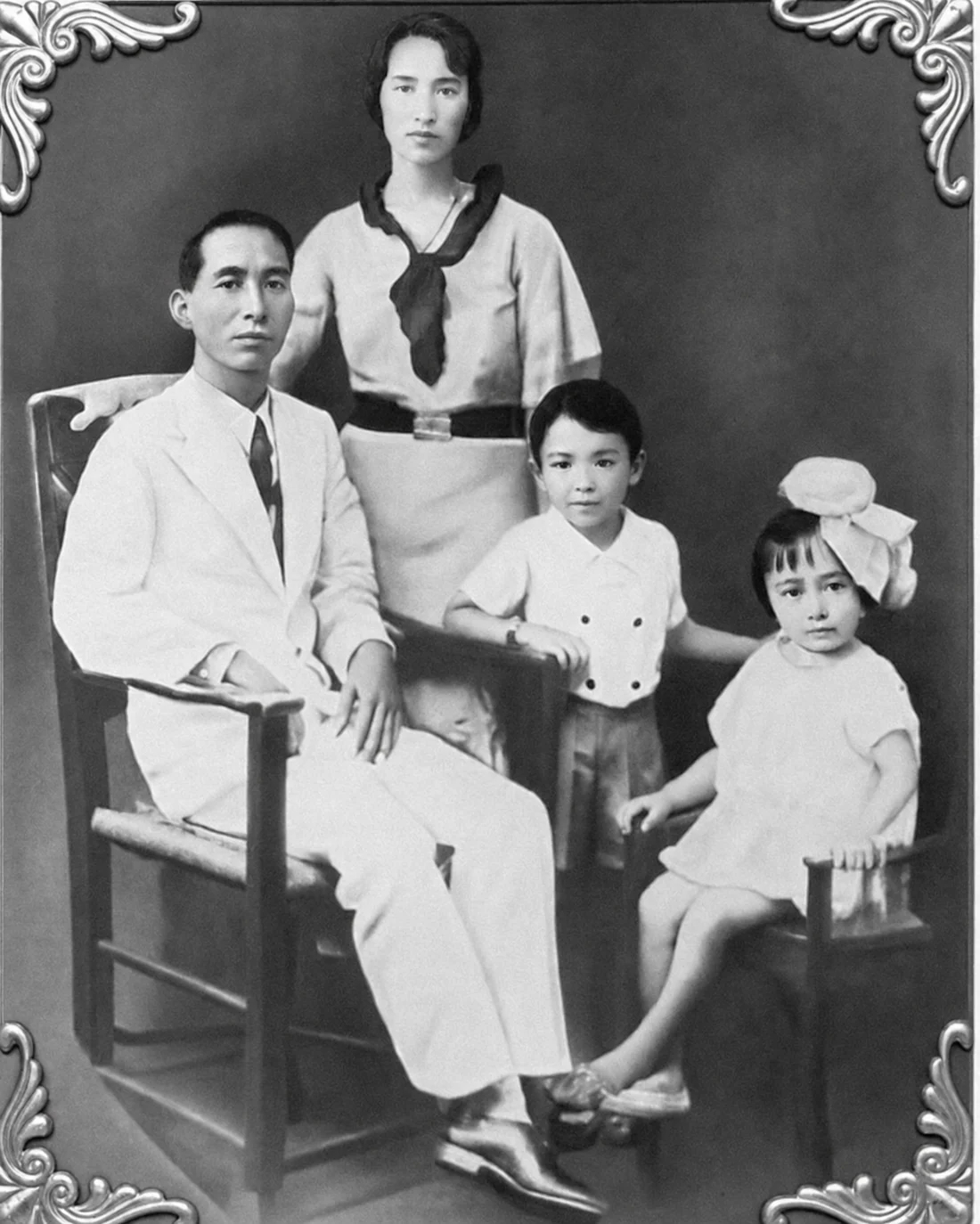
When I went to speak with the family, I was received by a woman in her late eighties, with a vivid memory and a curiosity that had accompanied her for decades. The story she carried was the same one she had heard as a girl. Her grandparents were Portuguese. The grandfather, a merchant who crossed the Atlantic, married, had several children and died relatively young, leaving his widow to raise their children. But no one could name the place they had come from. Portugal was an answer too large to fit on a map.
Above: Maria de Nazaré Alves with her husband and children, family photograph, reproduced with permission.
Her mother, Maria de Nazaré Alves, was the youngest daughter, and the only one born in Brazil. She married at seventeen, to a Japanese engineer who had come to Brazil not as a colonist but in the service of the Japanese government, charged with surveying the land before the founding of the Japanese colonies in the Amazon. It was one of the first marriages between a Japanese man and a Brazilian woman in the region, at a time when endogamy was common within local Japanese communities. But that is a story for another time, and I promise to tell it, for it deserves an article of its own. What matters here is that it was this marriage that bound Maria to Brazil. When Maria’s father died, the older brothers returned to Portugal to run the family’s affairs, and the sisters, in time, were taken to live with the grandparents on the other side of the ocean. Only the youngest remained. The mother, widowed, grew old here.
I like to begin each case with a long, unhurried conversation, because the clue to the document is often preserved, without anyone realizing it, in family memory. And it was in one of those conversations that the woman told me the phrase that decided the entire investigation. Her grandmother, she said, used to say that they lived so close to Spain that you could hear the roosters crowing on the other side of the river.
A phrase worth a map
A phrase like that could easily be dismissed as nostalgia, one of those images that families repeat without knowing where they came from. But I did not treat it as ornament. I treated it as a clue. There were details too specific to ignore. A river. Spain on the other side. A border so close that sounds from one yard could carry across the water. Now, in northern Portugal, the Minho River forms part of the border with Spain. That phrase, repeated across generations without anyone perceiving its value, narrowed the search area on its own. I was no longer searching all of Portugal. I was searching a narrow strip of the border, where the villages lean over the river and Galicia begins on the far bank.
When the usual sources do not exist
The problem was that I had an approximate location but no documentary entry point. Maria’s marriage certificate did not state the birthplace of her parents, a common thing in the records of that period. The older brothers, who might have left in Brazil a certificate or a foreigner registration card with their place of birth, could not help, because they had returned to Portugal and left no such trace here. I was facing a family split in two. Half went back and took with them the documents I needed to read. The half that stayed, a daughter and a widow, did not carry on paper the origin they carried in memory.
A narrower time frame, and a merchant
The next step was to narrow the time frame. If Maria was the only daughter born in Brazil, then the father was already settled here when she was born, and I knew the year he had died. I now had two endpoints for the search. The Brazilian life of that Portuguese man fell between the birth of his youngest child and his own death, and it was within that interval that I needed to search, not in an open, endless time.
It was then that I turned to a kind of source that few have at hand. For years I had been digitizing Portuguese consular register books and registration cards in Pará, an archive that preserves the life of the region’s Portuguese community like no other. This was an old case, and I had not yet indexed that material, so it was not enough to consult an index. It had to be reviewed page by page, year by year. But I had an advantage, because I understood the social profile of the man I was looking for. Anyone who studies consular registrations learns that a merchant was far more likely to register at the consulate than a farmer. A merchant needed to keep his ties with the Portuguese community and society, because his business often depended on those ties, and the consulate was, at that time, a meeting point for those people. A farmer isolated in the interior could live and die without ever presenting himself to a consul. A merchant was far more likely to appear in the consular records. I began at the year of his death and worked backward, within that span, in search of the man whom logic said I would find.
And I found him. The grandfather’s consular registration card was there, and in it, at last, the origin of the family, a village on the banks of the river Minho, on the border with Spain. The grandmother was right. From the yard of that village, the roosters on the far bank were indeed Spanish roosters. The phrase that seemed poetry was topography.
Cases like this taught me never to dismiss what a family repeats. Oral memory gets dates wrong, muddles names and invents kinships. But sometimes it holds, in a detail no one can explain, the exact coordinate of where it all began. I do not claim that every memory is true. I say only that it is worth listening to with attention, because a phrase about roosters crowing on the other side of a river can be worth more than a map to someone who knows how to read it.
Mnésis, documentary, genealogical, and historical research. From your roots to your future.