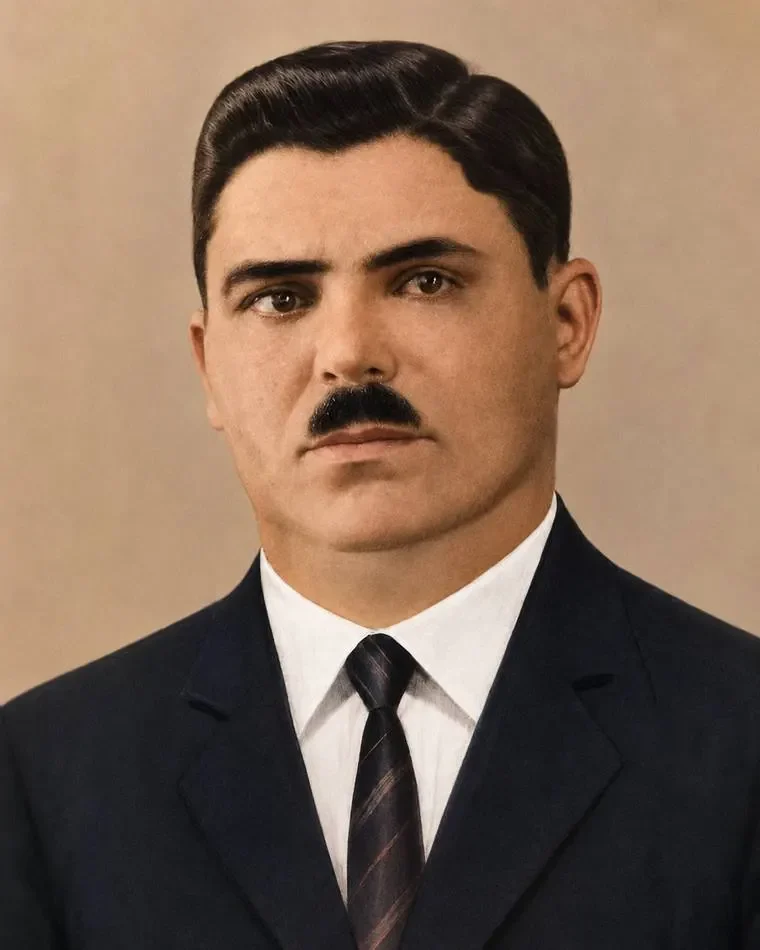
When the family of Manuel Nascimento Vasconcelos came to me, I was still at the start of my career. I had some experience, enough to trust the techniques I knew, but nothing that could prepare me for the case that would become the longest of my life. I spent six years searching for him. And, contrary to what you might expect, the problem was never the lack of documents. It was the excess.
Above: Manuel Nascimento Vasconcelos, restored family portrait, reproduced with permission.
He had left traces everywhere. He had lived in Recife at the start of the twentieth century, when there was a considerable Portuguese community there. He married twice and had many children. He was a merchant, the owner of a bar and a billiard hall, appeared in the newspapers and was involved in a lawsuit. Each of these things is usually enough to reveal an immigrant’s birthplace, because in a record, in a lawsuit, in the identifying details recorded in court files, someone almost always noted where the person came from. I had all those doors before me. None of them opened.
Many traces, no origin
I began the usual way, and it carried me far, but never to the place. Through the birth record of a son, I discovered a coincidence that touched me closely. Before Recife, Manuel had passed through Belém. He had left Portugal, landed in Pará, married in my own city to a Portuguese woman, and only then moved on to Pernambuco, where he was widowed and married again. I pursued this with hope. But neither marriage record stated his place of origin. The court file listed him simply as Portuguese. And in the consular records of Belém there was nothing, because Belém had been only a passage, a brief station in that family’s life.
So I followed the other traces, one by one. I went to the Commercial Registry, the Junta Comercial, because a merchant leaves a record. I went to the judicial archive in Recife, which holds one of the great collections of the country, looking for identifying details in the court files. I went to archives, to passenger and embarkation lists for Belém, and to passport registers. I even identified the ship that had carried him from Lisbon, but the date fell outside the period when passport files were kept, and even the passenger record yielded no place of origin. I had the ship, the marriage, the mother, the children. I had everything except the one fact I needed: where he came from. Every trail, without exception, ended in the same word. Portuguese. And nothing more.
Looking beyond the man
One thing I learned, and this case taught me as no other, is that when the trail of the man himself leads nowhere, you must stop and look at the people around him. One path caught my attention. In the second marriage, the record said that the father was already deceased, but that the mother was alive and living in Recife. A mother alive in the city was a new source. I searched for her death record everywhere. There were mentions of her, but the record did not appear. I tried the first wife, Portuguese like him, on the hypothesis that migrants often married within regional networks. I located her village, but it was not his. I went to the witnesses of the marriage banns, because often one of them declares having known the groom since Portugal, and that points to the place. Manuel’s witnesses, however, knew him from Recife. Every side door I opened led to the same empty courtyard.
And I lacked what usually saves these cases, the family’s memory. The children were too small when the father died. They kept no story, no phrase, no name of a village. There was no ancestor’s drawer to rummage through. There was only an old portrait, one of those repainted by hand, and a surname.
Off the beaten path
On one of my trips to Recife, I decided to search where no one usually searches. The classic databases, the ones every historian consults, had already failed. I went to the cemetery to see the grave, in the hope of a date, of finding the mother buried alongside him. Nothing. It was then that I learned of a book kept in one of the city’s archives, outside any index, off the usual path of research. It was a register of Portuguese residents in Recife, more than five thousand names, between 1909 and 1920. I digitized that book page by page. And it was there, among thousands of his countrymen, that I came face to face with him.
The book also gave me what six years of searching had not. Manuel had a brother living in Recife, who had never appeared in any of the sources I had followed. And, at last, the origin. Manuel Nascimento Vasconcelos was from Trás-os-Montes. A man from behind the mountains, from a village set in a Portugal of ridge and stone, far from the sea by which he had departed. After six years, the repainted portrait finally had a landscape behind it.
What is gained in six years
I do not like to say that I lost six years on that case, because the word lose is too heavy and, ultimately, false. I gained a great deal. I gained the experience of dealing with frustration. I learned that many trails lead nowhere, and that knowing when to abandon them is part of the method too. I learned to look beyond the man. And, by digitizing and indexing that book, I made sure I would never again lose six years searching for a Portuguese man in Recife, because what once cost me so much is now preserved and indexed.
But what I gained most was the family. I witnessed their frustration and their waiting, and in the end I received their trust and their gratitude, because I never gave up on the research. I say this to my clients with honesty. Sometimes I deliver a report stating that the document was not located, because that happens and I do not invent an origin to please anyone. But I never forget the name of a person I have searched for. This case lay dormant for months at a time, more than once. And even so, every time I went back to Recife for another job, he was there, in my memory, waiting.
The Vasconcelos family stayed with me. We secured Portuguese citizenship for his son, then for the grandchildren, and we are now working on the great-grandchildren’s cases. After spending so many years searching for one man, I had the privilege of seeing his great-grandchildren born and grow. What began as the search for a certificate became a bond that lasted across generations. And the old portrait, the one the family repainted without fully knowing the man it depicted, today has a name, has a brother, has a village behind the mountains and a lineage stretching across generations.
Mnésis, documentary, genealogical, and historical research. From your roots to your future.