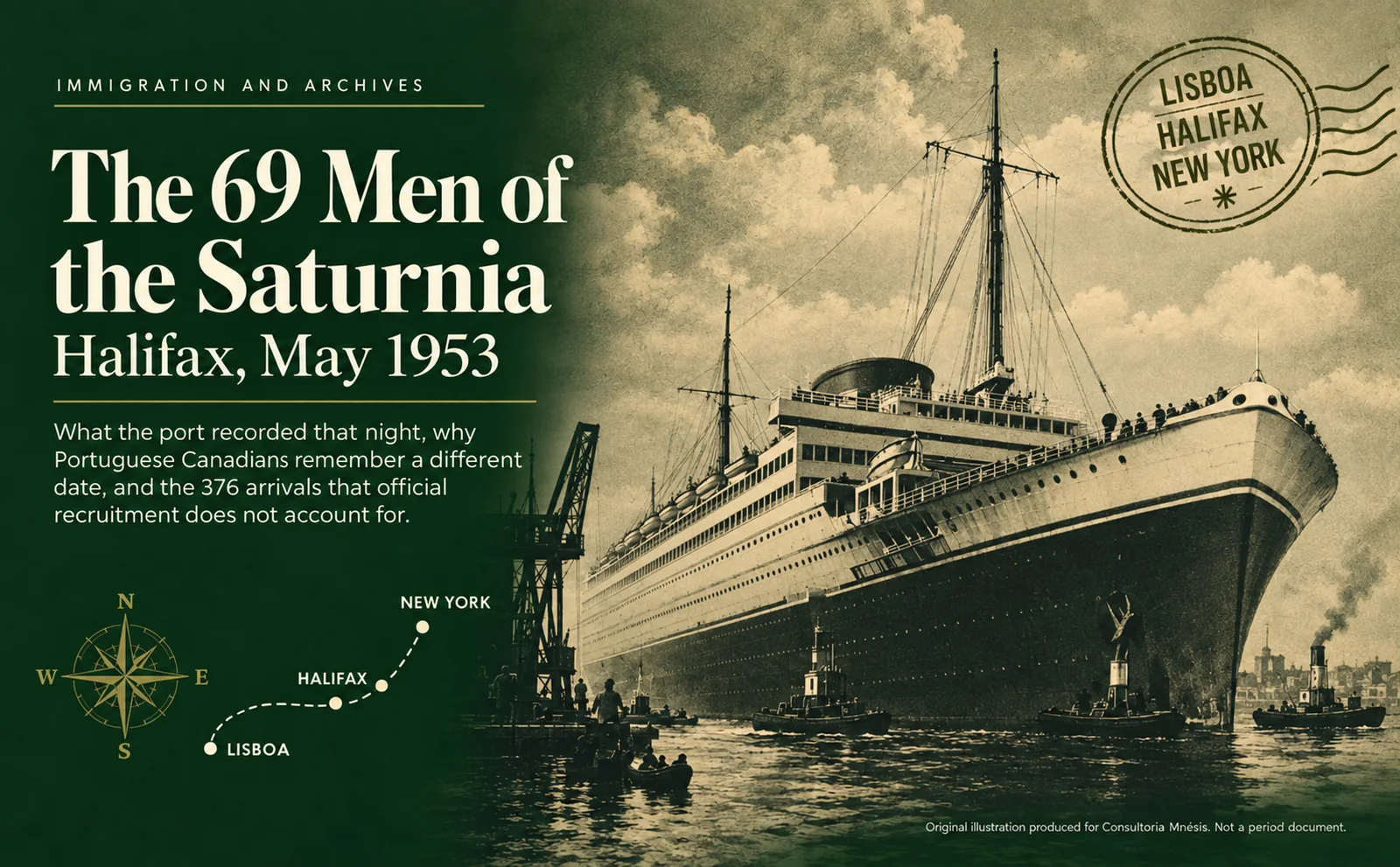
On the night of Thursday, 14 May 1953, eighteen hundred people came ashore at Halifax, Nova Scotia, from four liners. Port, immigration, customs and railway staff had one of their busiest days in years, and the Canadian National Railway sent out five special trains to clear the crowd. Close to three hundred Irish were among the 1,139 passengers of the Georgic, chartered by Cunard. And among more than five hundred passengers aboard an Italian liner were sixty-nine Portuguese, most of them tradesmen, bound for jobs in Ontario and Quebec.¹
The four ships of that night were the Saturnia, the Roma, the Georgic and the Stavangerfjord.² They belonged to a nine-ship week that brought some four thousand Europeans into the same port, from the Stockholm and the Veendam on the Wednesday to the Waterman, the Neptunia and the Jerusalem on the Saturday.³
Those sixty-nine men are celebrated today as the pioneers of a Portuguese Canadian community that now numbers more than half a million people. That night, nobody in Halifax noticed them. What survives of them is a single sentence in a wire dispatch that was mostly about the Irish.
Five Numbers for the Same Group
Seventy years on, the community still does not agree on how many they were.
The Consulate-General of Portugal in Toronto puts the group at sixty-nine.⁴ Manuel de Sousa Arruda, born in Bretanha, Ponta Delgada, who sailed aboard the ship and was interviewed in the 1970s by the historian Domingos Marques, counted his own: eighteen Azoreans and sixty-seven mainlanders, eighty-five in all.⁵ The Montreal record of the Azorean pioneers gives eighteen, which is the island contingent taken for the whole. A Toronto newspaper feature published for the sixtieth anniversary speaks of eighty-six, all men, nine of whom were thought to be still alive in 2013.⁶ And a wire dispatch from April of the same year gave two hundred and eighteen.⁷
One of these numbers was written on the wharf, on the day, by a reporter with no reason at all to inflate it or shrink it. The others were written from memory, decades later, or for an anniversary.
Even so, the press of the day should not be taken as infallible merely because it is of the day. In that same week, on the two ships that arrived on the Wednesday, one agency wrote 383 people and another wrote 386.² ³ And the Georgic figure of 1,139 was printed the day before the ship berthed, as a forecast, then repeated the following day as though it were a count. The port arrival record gives 1,112.⁸
Weighed against all of that, the number written on the wharf that day remains the soundest we have: sixty-nine.
This does not discredit Arruda, who is the best source for everything else and whose memory holds up on point after point. A man counting his countrymen aboard a ship carrying more than five hundred passengers, where Italian predominated and where Greeks, Italians and Poles were also travelling, can miscount easily. And not every Portuguese aboard that ship was landing in Canada: the liner was continuing to New York.
The Night of 14 May, and Why the Community Remembers the 13th
Portuguese Canadians commemorate 13 May 1953. Arruda remembered reaching Halifax at midnight.
The dispatch, however, is explicit, and it ran in three independent papers: the eighteen hundred came ashore on the Thursday night, which was the 14th.¹ The port arrival record enters the Saturnia on that same 14 May, with 535 passengers, and enters the Georgic on the same day.⁸ And Arruda says he left Lisbon on 8 May, which gives six days at sea.
One detail calls for care. The shipping movement tables printed on the Friday by two Ontario papers list the Roma, the Georgic and the Stavangerfjord as having arrived at Halifax on the Thursday, and do not include the Saturnia. Yet they list the Saturnia as sailing from Halifax for New York that Friday, alongside the other three.⁹ A ship that leaves a port entered it.
Either the compiler left it out of the arrivals list, and there is reason to doubt him, since the same table sends the Georgic to New York when the Georgic was bound for Quebec, or the ship berthed outside the hours the column covered, that is, in the small hours. The second reading is precisely what Arruda describes, and it reconciles everything: the community fixed the hour the men arrived, the port entered the day the ship came in.
That is a reading, not a finding.
There were two Italian liners at Halifax that night, the Saturnia and the Roma, and the dispatch refers only to the Italian liner, in the singular. Not every paper that carried it printed the name: one sets, in its place, a word that makes no sense in the sentence, and another solves the problem by deleting it. The likeliest reading is that the original said Saturnia and the compositor read Saturday. The name of the ship is established by other means: by the testimony of a man who sailed on her, by the passenger count, and by the record of her sailing for New York on the Friday.
The 1952 Trial and the Junta da Emigração
The first thing to clear away is the idea that it all began that night.
Ottawa had been turning down Portuguese emigration proposals since 1923. When, in February 1947, the Canadian consul in Lisbon, Lester Glass, told his government that the Portuguese press had reported an easing of the restrictions, he began receiving an average of twenty applications a day, and the following month counted eight hundred letters in four weeks.¹⁰ That same year Salazar banned emigration except under contract or under a state-to-state agreement and, recognizing that he could not enforce the ban, created the Junta da Emigração.¹¹ From then on, leaving Portugal was an administered act, and therefore a recorded one.
In 1952, before any general agreement, Ottawa accepted thirty-five skilled Portuguese workers on a trial basis.¹² The trial went well and opened the door to the following year.
The diplomatic archive is not the only source for this. In November 1955 a Portuguese immigrant wrote to the Montreal Star denouncing the working conditions of his countrymen on Quebec and Ontario farms, and opened the letter with exactly that point: the first experimental group reached Canada in the spring of 1952.¹³ His name was Henrique Tavares Bello, and four years later he would found the first Portuguese-language newspaper in Canada.
The Saturnia does not begin the Portuguese presence in Canada. It begins mass migration.
Why Ottawa Excluded the Azores
The most forgotten detail of this story is that Canada began by refusing the islands.
When the Portuguese chargé d'affaires in Ottawa negotiated the first movement, the Canadian officials confined recruitment to the mainland. They argued that public opinion was hostile, that they feared attack in Parliament, and that Azoreans would adapt poorly to the climate. Portuguese diplomacy pressed the point, noting that recruitment had already begun in the islands and had already cost the candidates money. Close to four thousand islanders had registered. Ottawa conceded a quota of twenty Azoreans, on condition that they be examined in Lisbon. The agreed total was 275 people.¹⁴
Twenty were authorized. Eighteen sailed.
Recruitment on São Miguel was announced by a notice posted at the parish church door, with a public session at the town hall of Ribeira Grande run by inspector Mário Ferreira da Costa, sent from Lisbon, who set a written test and an interview. Each candidate had to bring fifteen contos for expenses. They left Ponta Delgada on 21 April 1953, four days at sea in heavy weather, and spent a fortnight lodged at the Junqueira, in Lisbon.⁵
They went to Lisbon for an administrative reason, not a maritime one. The island quota had been granted on the express condition that the candidates be examined in the capital, and that is where the Canadian medical mission worked. Those men crossed half a country because of a clause.
It cost them dearly. Two failed the examinations, after making the journey: one from Arrifes and one from Livramento. A Junta official, moved by their case, waived their expenses and put them aboard the liner Vera Cruz for Brazil, with fifteen contos and a work letter, to spare them the humiliation of going home to the island.¹⁵
Twenty left the island. Eighteen crossed the North Atlantic. Two crossed the South Atlantic.
555 Entries, 179 Under Contract
The contracted movement of 1953 came in three sailings. The Saturnia, in May, with sixty-nine. The Vulcania, later that month, with seven, a figure some community sources raise to nine. And the Nea Hellas, in early June, with one hundred and three men from Madeira, which others count as one hundred and two.
That is one hundred and seventy-nine. Portuguese diplomatic records give one hundred and eighty workers actually recruited that year, against the 275 agreed, because the engineers withdrew on learning that their credentials would not be recognized and the recruitment of skilled workers in Oporto fell short.¹⁶
A difference of one. On the official side of the movement, the Portuguese and Canadian accounts agree.
And this is where the number nobody commemorates appears.
In February 1954 a spokesman for the Canadian immigration department stated, in a dispatch carried across the country, that 555 Portuguese immigrants had entered Canada the previous year.¹⁷
One hundred and seventy-nine came through the agreement. The remaining three hundred and seventy-six entered by some other route.
The discrepancy alone does not say which route. It says that one existed. Re-emigrants arriving from Venezuela, Brazil or the United States, relatives joining men already settled in Canada, crewmen who left the cod fleet, arrivals on visitor status: these are hypotheses capable of explaining part of the number, and none of them alone explains all of it. Gilberto Fernandes, who first examined this statistical discrepancy, points the same way, and notes that the Portuguese cod fleet carried some five thousand fishermen a season into North Atlantic waters.¹⁸
The gap between the two sets of accounts is not a statistical error waiting to be corrected. It is the documentary measure of what official recruitment does not explain. And it is where the search for the other three hundred and seventy-six begins.
The 1,800 Portuguese at St. John's, Newfoundland
Thirteen days after the Saturnia berthed at Halifax, a Canadian Press correspondent wrote from St. John's, Newfoundland, that twenty-three vessels of the Portuguese cod fleet had already called there that year to take on supplies. Each ship carried around three hundred men. At the weekend, with the fleet in, some eighteen hundred fishermen filled the waterfront, washing clothes and buying gifts to carry home, shirts drying in the rigging. The hulls were yellow. Two of the ships were square-rigged, and one of them, the Gazela, was reckoned to be at least a hundred years old. Once fuel, salt and provisions were aboard, they sailed for the Grand Banks, returning to St. John's in September before heading for Greenland waters.¹⁹
The arithmetic is worth pausing on. In the same month that sixty-nine Portuguese landed at Halifax, at the start of the great migratory wave, eighteen hundred Portuguese stood on a Canadian wharf, and left.
In January of that year a western Canadian paper reproduced an observation from the Newfoundland press: no foreign language was as familiar to the province as Portuguese, and its ties of friendship and trade with Portugal were older than those it had with the rest of Canada.²⁰
This is one of the routes capable of explaining part of the three hundred and seventy-six. A man who stayed ashore at St. John's generated no Portuguese record of departure for Canada, because he had left Portugal as a crewman.
Alonso Carreiro Waited Thirty-Six Years
Seven weeks before the Saturnia berthed, a Montreal paper photographed a Portuguese man receiving his American visa from the United States consul.²¹
His name was Alonso Carreiro and he was a watchmaker in Montreal. He had lived five years in Newport, Rhode Island, as a child, until his parents took him back to Portugal in 1912. He first applied for the visa in 1917, when his father died, and had to wait out the war. He tried again afterwards and could find no sponsor. There was a quota: four hundred and forty Portuguese nationals a year, close to half of it absorbed by the colonies, with preferential cases deducted on top of that. The Second World War cancelled every application. When the restrictions lifted in 1945 he stood near the head of the list, but the preferential cases were too many.
In 1949 he understood that he would wait indefinitely and decided to come to Canada. He settled in Montreal and resumed the pilgrimage, now to the American consulate there. In December 1952 a change in American law took Portuguese men married to United States citizens out of the quota, and his number came up.
The body of the report says thirty-eight years of waiting. The caption under the photograph, on the same page, says thirty-six. From 1917 to 1953 is thirty-six. Not even the paper that told the story could hold on to its own figure.
Carreiro is not one of the three hundred and seventy-six, because he entered Canada in 1949. But he is their type. Canada was not his destination. It was the waiting room. And that is why men like him appear on no Lisbon list bound for Canada.
February 1954, Hamilton Protests Before They Arrive
The same dispatch that gave the 555 announced what was coming: about nine hundred Portuguese would sail over the next two months for railway construction, farming and other work. One ship would leave the Azores on 22 March and another on 23 April, with around 450 on each sailing. A Canadian team, headed by O. Cormier of Quebec City, immigration attaché in Paris, would examine the candidates.¹⁷
The reaction arrived before the men did. Two days earlier, in Hamilton, the city s two rival labour bodies spoke on the same day. John Hancox, secretary of the Trades and Labour Council, called for tighter immigration control, stressing that he was not against immigrants, but that they should come where they were needed and when the labour market could absorb them. Stewart Cooke, secretary of the Hamilton Labour Council, called it an unfortunate case and an unplanned government decision.²²
The men reached Halifax on Saturday, 27 March 1954. The Hamilton press put the movement at four hundred; the Canadian Press dispatch datelined Montreal counted 331 on the train that reached the city on the Sunday night. Ninety-seven stayed in Montreal and the rest went on to Kingston, Belleville, Chatham, London, Niagara Falls, Windsor, Toronto and Hamilton.²³
Thirty-one stepped down at the Canadian National Railway depot in Hamilton on Monday, 29 March. They were all men, between twenty-five and thirty. The immigration supervisor said that before that day there had probably not been a single Portuguese in Hamilton, and that within three hours, with an interpreter, they were already assigned to the surrounding counties. One of them said he had been ploughing since he was eleven.²⁴
Not every arrival went that way. The following week a Kingston editorial headed Somebody Bungled reported that six Portuguese lads from the same contingent had spent their first night in Peterborough in a police cell, without coats, without money and without English, and laid the blame on the immigration service. The same piece puts the Ontario contingent at two hundred and thirty men, one hundred and twenty of them recruited in the Azores.²⁵ In Ottawa, twenty-five were lodged at the YMCA, and the interpreter the federal service found for them was Spanish.²⁶ There was no Portuguese speaker to talk to the Portuguese.
Hamilton has one of the largest Portuguese communities in Ontario today, and it was born that morning, on a railway platform.
How He Left Decides Which Records Exist
This has a direct bearing on anyone who, seventy years later, is looking for a grandfather.
Two families in Ontario can say exactly the same sentence, that their grandfather came to Canada in 1953, and be describing documentary paths that are opposites.
The man who boarded the Saturnia passed through the whole machinery of the Estado Novo: registration, parish notice, written test, certificates, two rounds of medical examination, political assessment, exit authorization. Every stage produced paper, and that paper stayed in Portugal, carrying his parents' names, his parish, his declared age and his signature or his cross. The man who jumped ship at St. John's, Newfoundland, or who arrived from Caracas on a visitor's visa, crossed the same year leaving none of it.
On the Canadian side the difference is harsher still. Publicly accessible passenger lists end in 1935. Everything that entered Canada from 1 January 1936 left the custody of the national archive and can be obtained only by a named request, case by case, under privacy restrictions.²⁷ There is no public manifest for the Saturnia. The full list of those sixty-nine men is not missing by accident. It is closed by rule.
Among the cases examined at Consultoria Mnésis, the useful first question is almost never when the ancestor arrived. It is under which regime he left. The answer determines what documentation exists, where the chain can be rebuilt, and, in nationality files, what can actually be proved.
In February 1948 a Canadian journalist in Lisbon described Portugal as a country of eight million people where the state subsidized bread and where a factory often meant a small group of men working in a shed.²⁸ Five years later, sixty-nine of those men came ashore at Halifax among eighteen hundred people, and nobody noticed. The following year, in the first five months alone, 1,058 Portuguese entered Canada, against 118 in the same period of 1953.²⁹
The whole history of Portuguese emigration to Canada fits inside that interval, and no part of it can be recovered without the documents that hold it up.
Sources
- The Ottawa Journal, 15 May 1953, p. 3; Victoria Daily Times, 15 May 1953, p. 2; The Calgary Albertan, 16 May 1953, p. 5. British United Press dispatch, datelined Halifax.
- The Hamilton Spectator, 14 May 1953, p. 43. British United Press dispatch, datelined Halifax, 14 May.
- Saint John Times-Globe, 14 May 1953, p. 15; The Daily Gleaner, Fredericton, 14 May 1953, p. 7; The Toronto Star, 14 May 1953, p. 3; Telegraph-Journal, Saint John, 15 May 1953, p. 13. Canadian Press dispatch, datelined Halifax.
- Consulate-General of Portugal in Toronto, official page.
- Testimony of Manuel de Sousa Arruda, recorded by Domingos Marques in Toronto in the 1970s, published in Milénio Stadium, Toronto, 2023.
- The Toronto Star, 3 July 2013.
- Agência Lusa, dispatch of 14 April 2013.
- Record of ship arrivals at the port of Halifax, 1953. Documentation consulted by Consultoria Mnésis.
- The Hamilton Spectator, 15 May 1953, p. 21; The Toronto Star, 15 May 1953, p. 34. Shipping movement tables.
- Gilberto Fernandes, Moving the Less Desirable: Portuguese Mass Migration to Canada, 1953 to 74, The Canadian Historical Review, vol. 96, no. 3, September 2015, pp. 339 to 374, here p. 345.
- Decreto-Lei no. 36:558, of 28 October 1947.
- Fernandes, cit., p. 346.
- Letter from H. Tavares Bello, The Montreal Star, 16 November 1955, p. 14.
- Fernandes, cit., p. 348.
- Fernandes, cit., p. 349, drawing on Domingos Marques and João Medeiros, Portuguese Immigrants: Twenty-Five Years in Canada, Toronto, Marquis Printers, 1980.
- Fernandes, cit., p. 351.
- The Ottawa Citizen, 20 February 1954, p. 4; The Montreal Star, 20 February 1954, p. 30; The Hamilton Spectator, 20 February 1954, p. 7. Canadian Press dispatches, datelined Ottawa.
- Fernandes, cit., pp. 367 and 368.
- Steve Herder, Canadian Press dispatch datelined St. John's, Newfoundland, Niagara Falls Review, 27 May 1953, p. 2.
- The Leader-Post, Regina, 9 January 1953, p. 13, citing the St. John's Telegram.
- Stan Twardy, The Montreal Star, 26 March 1953, p. 28.
- The Hamilton Spectator, 18 February 1954, p. 7; Waterloo Region Record, 19 February 1954, p. 2.
- The Gazette, Montreal, 29 March 1954, p. 19; The Moncton Transcript, 29 March 1954, p. 1; The Windsor Star, 29 March 1954, p. 15.
- The Hamilton Spectator, 30 March 1954, p. 8.
- The Kingston Whig-Standard, 2 April 1954, p. 4.
- The Ottawa Citizen, 31 March 1954, p. 16; The Ottawa Journal, 2 April 1954, p. 30.
- Library and Archives Canada, publicly accessible passenger lists to 1935; entry records from 1 January 1936 held by Immigration, Refugees and Citizenship Canada, obtainable only by named request, under privacy restrictions.
- Stuart Underhill, Canadian Press dispatch datelined Lisbon, The Kingston Whig-Standard, 27 February 1948, p. 6, and Daily Standard-Freeholder, Cornwall, 27 February 1948, p. 16.
- The Hamilton Spectator, 10 July 1954, p. 15; The Gazette, Montreal, 10 July 1954, p. 15. Canadian Press dispatch, datelined Ottawa.