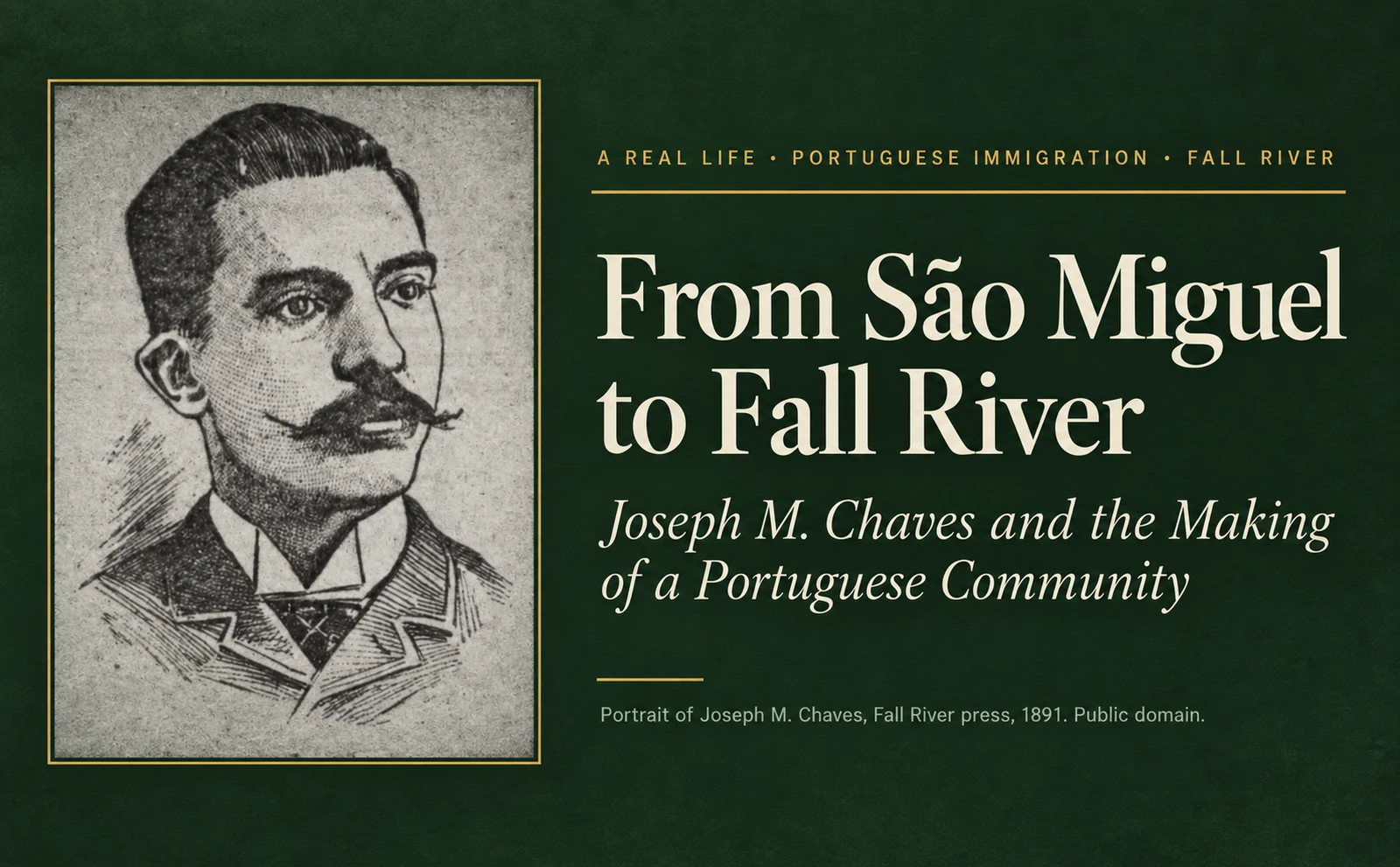
On October 25, 1887, Joseph M. Chaves appeared before the Second District Court of Bristol and declared his intention to become an American citizen. The document records him as a clerk, about twenty-two years old, living at 31 Anawan Street in Fall River. It also records what matters most for any family history. Chaves stated that he had been born in “St. Michael, Azores, Portugal,” the English form of São Miguel, on or about February 3, 1865, and that he had arrived in Fall River on September 4, 1884.1
Three years after reaching the city, the young immigrant had begun the legal process of naturalization. Eight years later he was dead. Between those two moments, his name entered newspapers, societies, courts, commercial advertisements, political debates and the institutional life of Portuguese Fall River.
A Young Clerk on Anawan Street
Nothing in the 1887 declaration marks Chaves as a future public figure. He was young, he worked as a clerk and he lived on Anawan Street. The documents that follow show how quickly his position in the community changed.
By June 1889, Chaves was president of the St. Joseph’s Society. The officers and committees around him place a group of Portuguese names in the same institutional network: Louis J. Silva, Antone Pereira, James L. Fonseca, Peter J. Freitas, Joseph Ignacio, Jacinto M. Constantino, Manuel M. Dutra and Manuel V. Bezeiro.2 A community appears here not as a percentage but as people who knew one another.
The St. Michael the Archangel Society
In June 1890, Chaves was elected president of the St. Michael the Archangel Protective and Benevolent Society, which had about 157 members. Its officers included Manuel T. Mello, Manuel R. Sylvia, Manuel Da Luz, Manuel Arruda, Manuel Jose Fresca, Victory Enos and Manuel R. Pavao. The printed list also includes Joseph C. Reynolds and Joseph Doherty, and the newspapers do not explain their place in the society.3
The society’s structure is revealing. It had a president, vice president, secretary, financial secretary, trustees, a sick committee, a sergeant-at-arms and a marshal. This was more than a religious celebration organized once a year. It belonged to the world of immigrant mutual aid. A worker who fell sick could lose his income, and a family facing a death had expenses that could not wait. Through societies like this one, members contributed collectively and received help when misfortune arrived.
The model was not new. Portuguese immigrants in Boston had been running a benevolent association of this kind since the 1860s, as Before Fall River shows. In Fall River, Chaves stood at the center of it.
St. Joseph’s Society and a Portuguese Network
By December 1891, Chaves appeared again in the St. Joseph’s Society, now as corresponding secretary and trustee. The officers included John Silva, Joseph Soares, Manuel R. Carvalho, Antone Perry, Manuel John M. Dutra, Manuel M. Silva and Manuel V. Bezeiro.4
Two years earlier the same society had listed an Antone Pereira. Now it listed an Antone Perry. The newspapers do not say whether they were the same man, but the pair shows in miniature how Portuguese surnames moved into English forms, a process examined in The Portuguese Who Became Americans. The same lists print Silva as Sylvia and include Enos, the American form that often replaced Inácio.
The society also retained a physician. A newspaper praised the doctor for attending members who could not afford medical care and noted that the society’s finances were in good order. That detail shows what the association meant in practice. A surname such as Silva, Pereira or Dutra was tied not only to a church or a nationality but to an infrastructure of survival in an industrial city.
Chaves Became an Interpreter Between Two Worlds
Chaves also worked for leading clothing establishments in Fall River, and newspapers of the period associate him at different moments with Talbot and Company and C. H. Bloomer Company. His work soon extended beyond commerce. He became an interpreter at the district court, later a constable who served legal process for local attorneys, and he received an auctioneer’s license.
The significance is easy to overlook. A newly arrived Pereira, Freitas, Silva, Mello, Pavao or Fonseca who could not explain himself in English before an American court needed someone able to cross that linguistic boundary. Chaves could. Portuguese residents could encounter him not only inside their own societies but inside the institutions of Fall River. His career occupied the space between the immigrant community and the American city.
Chaves Wrote About Portugal in English
In September 1891, during celebrations connected with St. Michael’s Day, the Fall River Herald printed a long text supplied by Chaves about Portugal, navigation and national identity. It praised Portugal’s maritime past and the accomplishments of its navigators. Then it turned political. Chaves criticized the monarchy and expressed the hope that Portugal might one day become a republic.5
The timing matters. In January 1890, the British Ultimatum had forced Portugal to give up its claim to the lands between Angola and Mozambique, and the humiliation fed republican sentiment across the country. In January 1891, a republican uprising in Porto had been put down. Chaves was writing from Fall River about a debate that was shaking Portugal itself.
Five months later, Portuguese politics arrived inside one of Fall River’s societies. In February 1892, the St. Joseph’s Society received the Portuguese consul in Boston, whom the newspaper called Viscount Vallada Costa, together with Father Martin of New Bedford. The report mentioned rumors that Portuguese communities in America, described as largely Azorean, were unhappy with royal rule and that some favored American annexation or protection of the islands.6
Chaves took part in the meeting. The evidence does not establish that he supported annexation. It does show that political debates about Portugal and the Azores were circulating inside Portuguese Fall River.
“Defence of Portugal”
In March 1892, Chaves returned to the newspaper with an article titled “Defence of Portugal.” He was answering a local writer who had mocked Portuguese national pride, and he answered through history, writing at length about Afonso Henriques and the formation of the kingdom.7
The two texts are not contradictory. A man could oppose the monarchy of his own time while remaining deeply attached to Portugal as a historical nation. That distinction is one of the most interesting features of Chaves’s public voice. He was writing about what it meant to be Portuguese from inside an American city.
Naturalization Did Not End the Atlantic Connection
On November 21, 1892, the Fall River City Clerk certified that Joseph M. Chaves, twenty-seven years old, a clerk living at 26 Grant Street, had filed an application for naturalization.8 The age agrees with the birth date in his 1887 declaration.
Becoming American did not sever his relationship with Portugal. By 1894 he was working as a steamship agent. A newspaper notice reported that eight passengers had bought tickets through Chaves for the Azores and would leave New York aboard the Dona Maria for São Miguel. The notice also advertised travel to Brazil, California and the Sandwich Islands, as Hawaii was then called.9
Chaves had crossed the Atlantic as an immigrant. Ten years later he was selling the crossing to others. He had become part of the infrastructure of migration itself.
A Portuguese Union
In October 1894, Chaves published another letter, under the heading “A Portuguese Union.”10 His subject was the position of the Portuguese in Fall River: their treatment in public institutions, employment, political representation and the need to organize. The community that appears in the letter includes workers, voters, naturalized citizens and men seeking appointments or recognition in municipal life.
The names that had first appeared in benevolent societies were becoming part of a larger civic world. Six years later, a Portuguese Naturalization Club would take up the same questions of citizenship and the vote, as told in Fall River, America’s Portuguese City.
“I Do Not Pose as a Leader of My People”
In 1895, Chaves’s appointment as a constable became controversial. A petition from Portuguese residents supported him, and newspaper reports indicate that clergymen and established businessmen signed in his favor. Chaves wrote to the press to defend his record. One sentence stands out: “I do not pose as a leader of my people.”11
The documents explain why the question arose at all. By then he had presided over societies, interpreted in court, sold Atlantic passages and published political articles. He had become visible enough that his municipal appointment mobilized the community. Whether Chaves considered himself its leader matters less than the fact that others repeatedly treated him as a representative figure.
The Death Records Disagree
Joseph M. Chaves died in July 1895. One newspaper called him one of the most widely known Portuguese residents of Fall River and gave his age as thirty. It added that his mother had died about a year earlier and that he had buried a young child only days before his own death. At the time he lived at 110 Columbia Street.12
The municipal death registration gives a different age: thirty-four.12 That conflicts with the declaration Chaves himself made in 1887, which places his birth in February 1865, and with his recorded age of twenty-seven in 1892.
The divergence should remain visible. A historian does not repair conflicting records by choosing whichever number makes the story easier. In this case, Chaves’s own declaration is particularly strong evidence for a birth around 1865.
The Community Around One Man
The value of Chaves’s story is not that he was exceptional in isolation. It is that the documents around him preserve a network. Silva, Soares, Pereira, Fonseca, Freitas, Ignacio, Constantino, Dutra, Bezeiro, Mello, Sylvia, Da Luz, Arruda, Pavao and Enos all appear in the organizations and public world he inhabited.
Those surnames are genealogical entry points. Some descendants will recognize one immediately. Others may discover that the American spelling no longer resembles the Portuguese form used before immigration. Follow Chaves and other people enter the frame. Follow the society and families appear. Follow the family and, eventually, the Atlantic reappears.
Eleven Years in Fall River
Joseph M. Chaves was not one of the first Portuguese residents of Fall River. A Catholic mission for the city’s Portuguese had existed since 1876, and the Portuguese communities of Boston and New Bedford were older still.13 His historical value lies elsewhere. His eleven years in the city coincide with the period in which its Portuguese institutions became increasingly visible.
He arrived as a young clerk and left the record as a society president, court interpreter, constable, steamship agent and a Portuguese voice in an English-language newspaper. Through him we can watch an immigrant community solve practical problems: how to care for a sick member, how to speak before a court, how to become an American citizen, how to buy passage for another Atlantic crossing, and how to remain deeply Portuguese while building a life in Massachusetts.
When the Fall River Press estimated the Portuguese population of the city and its surroundings at about 9,000 in 1903, Chaves had been dead for eight years.14 The institutions and families he knew remained.
At Consultoria Mnésis, that is where documentary research becomes historical reconstruction. One naturalization record can lead to newspapers, societies, relatives, migration networks and, eventually, back to Portugal. Joseph M. Chaves left enough traces for us to see not only one immigrant life but a Portuguese community being built around it.
Sources
- Declaration of intention of Joseph M. Chaves, October 25, 1887. Primary documentation located by Consultoria Mnésis.
- Fall River Herald, June 24, 1889.
- Fall River Tribune and Fall River Herald, June 16, 1890.
- Fall River Herald, December 21, 1891.
- Fall River Herald, September 8, 1891.
- Fall River Herald, February 2, 1892.
- Joseph M. Chaves, “Defence of Portugal,” Fall River Herald, March 19, 1892.
- Naturalization documentation for Joseph M. Chaves, 1892. Primary documentation located by Consultoria Mnésis.
- Fall River Herald, May 25, 1894.
- Joseph M. Chaves, “A Portuguese Union,” Fall River press, October 1894.
- Fall River press, 1895; Joseph M. Chaves, letter in the Fall River Herald, April 3, 1895.
- Fall River Herald and Fall River Globe, July 1895; death registration of Joseph M. Chaves, 1895. Primary documentation located by Consultoria Mnésis.
- Senhor Santo Christo dos Milagres Parish, historical account of the Portuguese mission in Fall River. https://www.santochristo.com/files/128255270.pdf
- Fall River Press, November 13, 1903.