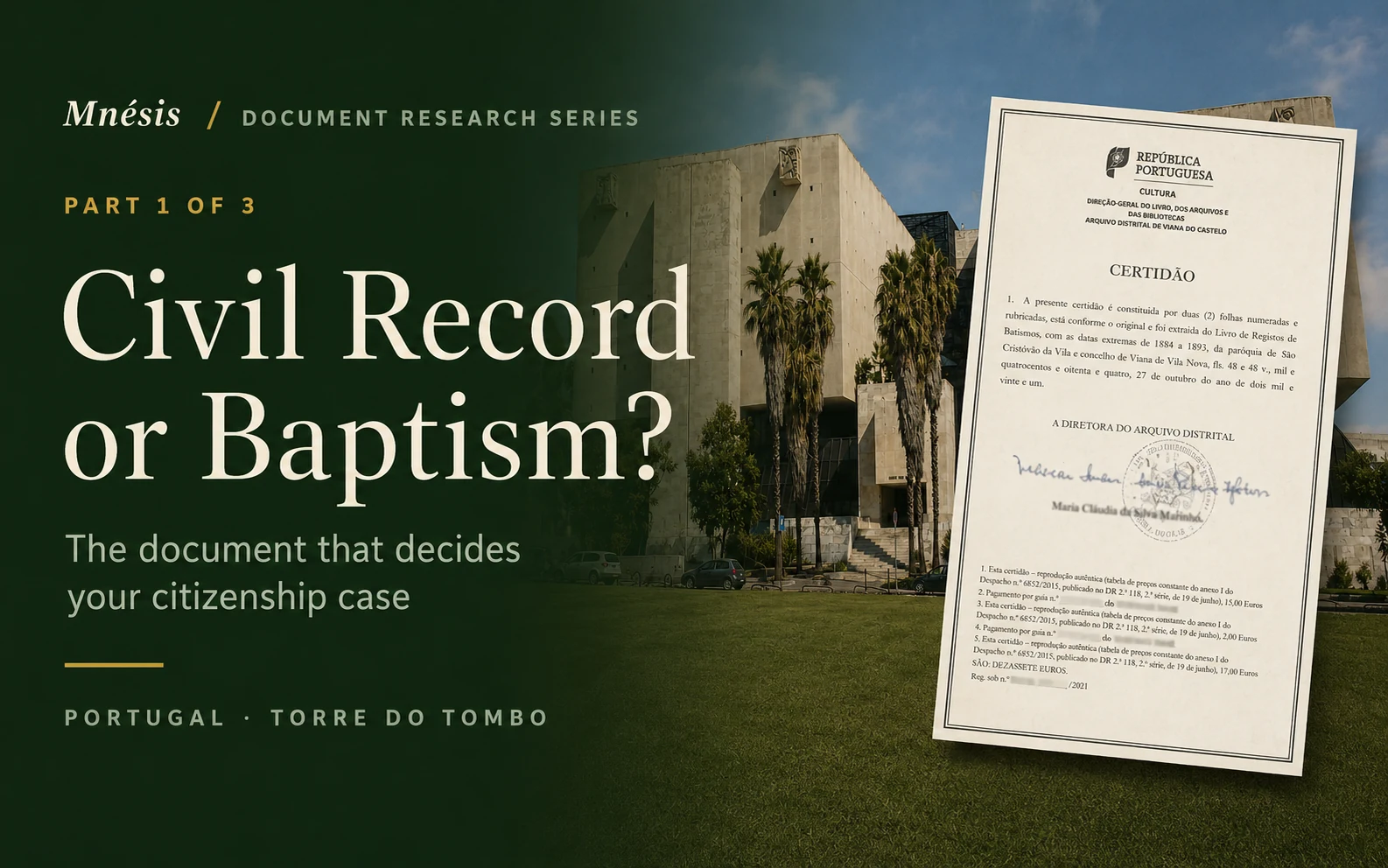
Every week, in one form or another, the same question reaches me. Sometimes it comes as a technical question, sometimes as a confession: “I couldn't find my ancestor's birth record. All I have is the baptism. Does that count?” Or: “I found a record, but it was made many years after the birth. Does it work for the process?”
These are two recurring problems, and they come down to two questions that run through every citizenship case: where is the document, and which document can I use. They sound simple. They are not. The answer changes with the country, with the period, and with a history almost no one tells the client before they waste time and money on the wrong path. That history is what I want to tell here.
Before civil registration, everything was baptism
Civil registration, the State recording who is born, who marries, and who dies, is a more recent institution than people imagine. And each country has its own turning point. Knowing that date is the first step, because it decides which document you should be looking for.
In Brazil, mandatory civil registration begins on 1 January 1889. Before that, a few large cities such as Salvador and Rio de Janeiro had registry offices, but there was no obligation. What actually functioned, in part by force of the padroado, the crown's authority over the Church, were the parish records, the Church's own registers. So a Brazilian birth before 1889 is proven by baptism.
In Portugal, civil registration was introduced only on 18 February 1911, with the fall of the monarchy and the arrival of the Republic. Before that, the document that exists is the baptismal record in the parish book. Born before 1911, baptism; from 1911 on, civil record.
In Spain, the turning point is older still: 1 January 1871.
So it is not a registry clerk's whim when one document counts and another does not. The birth date is what governs. If I need to prepare a marriage transcription and the Portuguese ancestor's spouse was born before 1911, I use the baptism. Born later, it has to be the civil record. The same measure applies to the ancestor himself.
“I couldn't find the birth record. Can I use the baptism?”
Here is the point that stalls so many cases. When the ancestor, or the descendant who has to prove the line, was born after 1889 but the family only has the baptism, the inevitable question comes: can I use the baptism instead?
In the Portuguese process, no. A Brazilian baptism dated after civil registration came into force is not accepted by the conservatória, the Portuguese civil registry office, as a substitute for the birth record. And there is a further reason few people know: the Brazilian baptism is, as a rule, a poor document.
In Portugal, baptizing while recording the whole genealogy was natural, and the overwhelming majority of Portuguese parish records carry the names of the parents, the grandparents, the birthplace, the godparents. It was the norm. In Brazil, that was rare. It is very hard to find a priest who followed the full formula to the letter, the one that runs “I baptized the innocent so-and-so, born on such a date, child of so-and-so, grandchild of so-and-so, the parents married in the parish of so-and-so.” That rich formula is precisely the one civil registration inherited and formalized. Because civil registration is not a rupture with the religious record: it is the continuation, in the form of law, of a formality the sacramental records already carried.
A country the size of a continent
And why do so many people reach me without the birth record, or with one made too late? Here I have to speak as a historian, because the explanation is historical, and it is the key to this article.
Brazil is practically a continent. An immense territory, a scattered population, cities days apart from one another. And, most important, Brazilian law itself acknowledged that difficulty, in writing, again and again. It is not me, the researcher, saying that registering in Brazil was hard. It is the Brazilian State admitting it, decade after decade, in the text of the law.
Look at the chain. As early as 1919, a law provided for a late birth registration by order of a judge and two witnesses, and the late-registration procedure, which survives to this day, is born there. In 1930, a decree extended the registration deadline to four months when the birth took place more than thirty kilometers from the seat of the district, with no rail connection. Read that again: the law had to yield to distance, because the distance was real. In 1931, another decree required registration while waiving the fine and the justification for the delayed cases. And in 1939, a decree granted a full amnesty so that people would register the late births, with the deadline extended again at the end of that year.
Amnesty. Think about what that word means here. The number of people without a record was so large that the State, more than once, waived the penalty just to bring people into the system. All of this legislation, consolidated in the great regulation of 1939, which remained in force until the Public Records Law of 1973 and still lives on in today's rules, is the documentary proof of one thing: in Brazil, registering a child on time was the exception, not the rule.
Now contrast that with Portugal. We are talking about a nineteenth-century country of small villages, but villages structured for centuries, each with its church, its baptisms, its parish. When Portuguese civil registration is created, in 1911, it is born inside tiny, rooted communities, where everyone knew everyone and where the priest had been recording everything for generations. A documentary reality that is simply not ours.
A criticism, and an honest concession
This is where I allow myself a criticism of the conservatória. But I will make it honestly, and I will start by granting its point.
When the Portuguese registry distrusts a late record, it is not being paranoid. The risk was real. The declaratory nature of these records, made on the word of the declarant and two witnesses, with no document contemporary to the fact, left an opening for distortion. In practice, I have run into situations where a child was registered as the offspring of a Portuguese man who was already dead when that child was conceived. And here a distinction matters: if the widow was pregnant at the moment her husband died, the child is his, legitimate, no argument. The problem is different. It is children conceived after the death, from a new relationship, and declared years later as if they were the dead man's. That could happen, and it did, thanks to that same territorial vastness: no one could check, a person moved from one town to another and made whatever declaration they wanted. Portuguese strictness, then, is not gratuitous. It answers a genuine problem.
But, and this is where the criticism holds, the answer to that problem need not be an absolute refusal. There is no need to discard the legitimate case along with the fraudulent one. There is a path that separates one from the other, and it has a name: documentary proof. Attaching to the late record, or to the baptism, a set of corroborating documents that confirm the parentage and the line. That is exactly what distinguishes fraud from truth, and it is exactly what the conservatória, today, does not allow. It accepts the reconstruction of a record only when it rests on an original document; corroborating evidence, however solid and convergent, is not enough.
And that is precisely the point where Portugal parts ways with the rest.
The same proof, three different answers
Because the same family situation that stalls in Portugal often moves in Spain and in Italy. Not because those countries are more permissive out of carelessness, but because they built exactly the mechanism that separates the legitimate case from the fraudulent one, instead of rejecting both at once.
In Spain, the baptism can be used even for births after civil registration was created, provided it comes with the certificate of no record from the registry. I locate the baptism, check the civil registry, and if it does not find the record, I attach the certificate of no record and the case can proceed. In Italy, the reconstruction of the record is accepted when the certificate cannot be located. In both, the logic is the same: corroborating evidence, attached to the document, resolves it. Flexibility is not laxity. It is a system that trusts documentary research to separate the true from the false.
That leaves the question that closes this article and opens the next ones: if Spain and Italy can, with corroborating evidence, tell the legitimate case from the fraudulent one and allow legitimate cases to proceed that would otherwise fail in Portugal, why could the Portuguese conservatória not do the same?
In the next two articles in this series, I open each of those doors. First the Spanish one, drawing on my experience with more than 800 Democratic Memory Law cases. Then the Italian one, and the particular view it takes of this kind of documentation.
From your roots to your future.