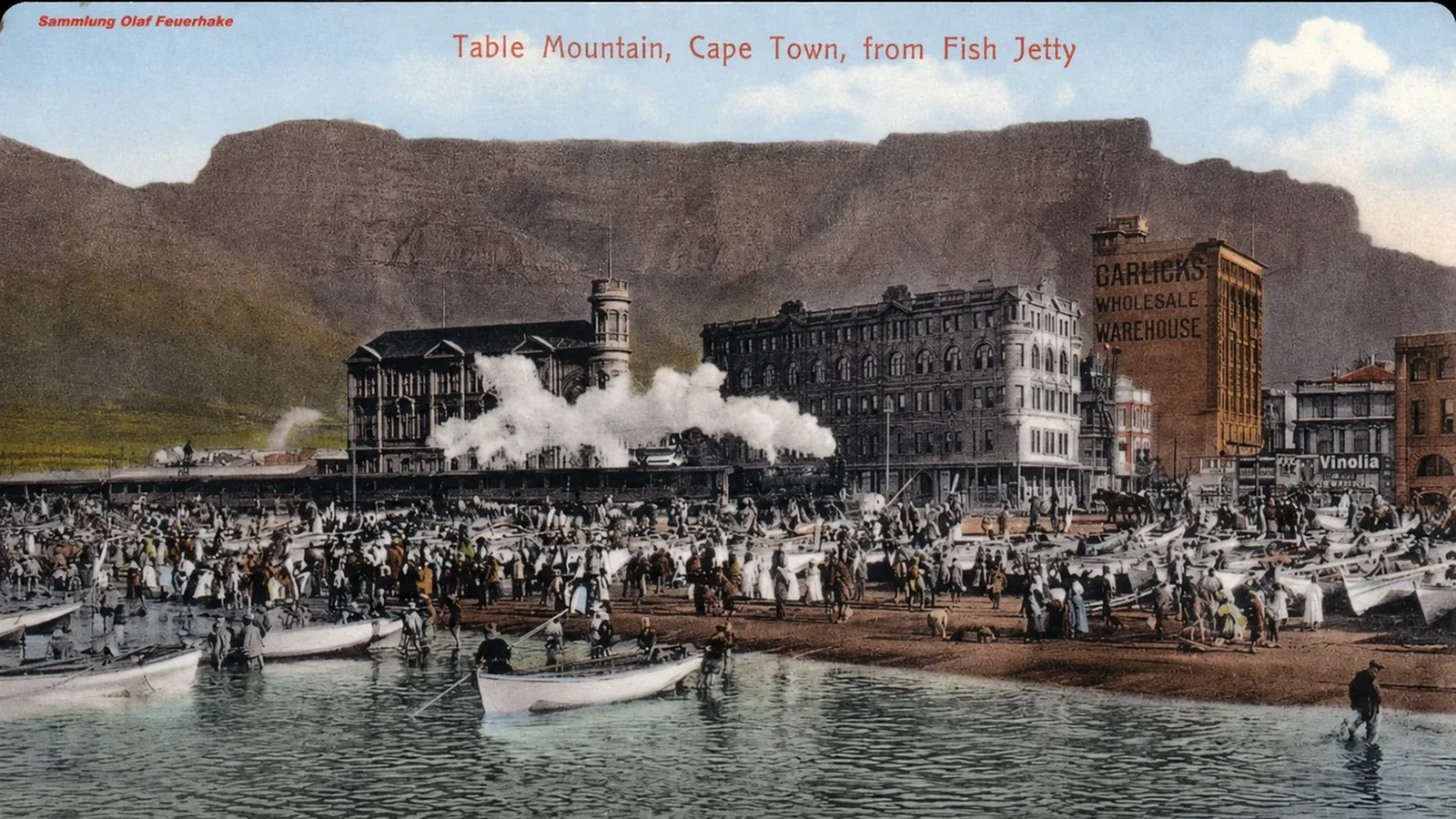
One of the world's largest Portuguese communities is also one of its least known. It is in South Africa. The community numbers in the hundreds of thousands, Portuguese nationals and their descendants alike. Estimates vary so widely that the range itself betrays how little is known: somewhere between three hundred thousand and half a million, with higher figures still when the second and third generations are counted. A community large enough to be one of the major centers of the Portuguese diaspora worldwide, and discreet enough to have been called, in an academic study, an invisible diaspora.
That invisibility is no accident. It comes from the way these people arrived, from where they came, and from the silence that settled between the generations. To understand who South Africa's Portuguese are, and why so many descendants no longer know exactly where their families came from, we need to look at three distinct waves of migration. They overlapped in time, but remained largely separate from one another.
The first wave: Madeira
The first wave is the oldest and the most numerous, and it is Madeiran. Madeira's ties to the Cape are older than one might imagine. By the early twentieth century the Portuguese presence there was already significant, and by 1904 Madeirans were the majority among the Portuguese. The route that carried them was the same that carried wine and goods, the Cape route, on which the steamers linking Europe to southern Africa regularly called at Funchal. In Madeiran memory the day those ships reached port even had a name of its own, the day of São Vapor, the Day of the Steamer, such was the anticipation it stirred. These pioneers, with little schooling, settled first in the Cape Province and then pushed on into the Transvaal and the Orange Free State, and made their living where there was room for those who arrived with little: fishing, farming, retail and distribution, almost always working for themselves.
This was no trickle of emigrants. In the 1950s and 1960s, the flow grew dramatically, driven by crisis on the island, by drought, by unemployment, and pulled along by the network of relatives and neighbors already on the other side. It was strong enough to leave its mark on Madeira's own landscape. Those who succeeded in South Africa came back and bought houses, and the houses of successful returnees carried a recognizable sign: the Marseille tile, a reddish roof tile that told the whole parish that someone in that house had gone to the Cape and prospered. The successful emigrant paid for the religious feasts of the homeland, and the first feast-sponsors returning from South Africa began to appear in the Madeiran press as early as the beginning of the century, changing even the splendour of the festivals of the island's interior.
The second wave: mainland Portugal
The second wave is continental, and it arrived almost a century after the first, in the mid-1960s. It looked very different. It came not from the island but from mainland Portugal, from Porto, Lisbon, Aveiro, Castelo Branco, Leiria, Santarém, Braga, Bragança, Setúbal, Faro, Guarda, Coimbra, Viseu. And it came not for the land or the sea but for industry. It was an emigration of skilled workers, with more formal education, drawn by South Africa's surge of industrialization, and they found work primarily in construction and metalworking.
The exact moment of that turn can be seen in the figures of legal emigration recorded by Portugal itself. Until the early 1960s, Madeira leads by a wide margin, year after year sending more people than the entire mainland. In 1963 the mainland overtakes the island for the first time, and in 1965 and 1966 it surges, with the peak of the whole period falling in 1966. The continental wave did not replace the Madeiran one, it added to it, and the two currents, as the research noted, occupied largely different economic niches and complemented one another, the second filling the sectors the first did not occupy.
The third wave: Angola and Mozambique
The third wave is the most sudden, and it came not from Portugal but from Africa. In 1974 and 1975, with the Carnation Revolution and a swift decolonization, the Portuguese world in Africa came undone in a matter of months, and hundreds of thousands of people had to decide, almost overnight, where to go. Most went to Portugal. But a portion, those who were in Angola and Mozambique and who still thought of themselves as in some way African, made another choice, and asked why not South Africa, right next door, where Portuguese had been established for decades. These refugees never entered the official statistics of Portuguese emigration, because those counts recorded only those who left the metropole legally, and they did not come from the metropole, they came from the former overseas provinces. Estimates for this flow alone range from 70,000 to 80,000 people, many of them professionally or technically qualified, doctors, teachers and other professionals, people who came to complement, and not to repeat, what those already there were doing.
What they built
Taken together, the three waves give a portrait, around 1991, of some three hundred and ten thousand people of Portuguese origin in South Africa, and even that number, coming from the diplomatic network, is admittedly a floor, because it never corresponded to the real size of the community, full of people who entered outside the records and of people who never registered at the consulate. Their impact was anything but small. The Portuguese came to hold the overwhelming majority of the country's trade in agricultural produce, dominated the tuna fishery in Cape Town, left a decisive mark on commerce, construction, and industry. The community gave rise to figures who became prominent, such as the Madeiran Joe Berardo, who emigrated at eighteen to Johannesburg and made his fortune there before returning to the island. They built entire neighborhoods with a distinctly Portuguese character in the south and east of Johannesburg, Rosettenville, Turffontein, La Rochelle, the so-called Portuguese belt, where the language, food, faith and festivals of home were preserved and recreated. They built clubs, newspapers, associations, the Academia do Bacalhau, the Casas da Madeira, the folklore groups, a dense communal life that survives to this day.
An invisible diaspora
And yet, an invisible diaspora. Why? Because each of the three waves came for a different reason, from a different place, and carried a history that was often not told to the children and grandchildren. The first generation worked, integrated, prospered in silence, and when the generations that followed look back, they find a surname, a vague mention of an island or of a province that no longer exists under that name, and little more. The thread, in many families, thinned until it all but vanished.
A thread can thin without breaking. And it is here that a community which seems invisible becomes visible again, when one looks at it not as an anonymous mass, but as the result of individual journeys that began in specific, identifiable places. Each of these three waves came from an origin that left a trace. The Madeiran came from concrete parishes, Estreito da Calheta, Prazeres, Fajã da Ovelha, Jardim do Mar, Ponta do Sol, Ponta do Pargo, Camacha, and each of those parishes has a documentary trail. The continental came from districts that can be named one by one. And that of the returnees came from a Portuguese colonial world that, however much it collapsed, was a world of records, of registers, of papers drawn up. None of these origins is a void. All are a point of departure.
The next two stories will follow those two trails: first, the families who reached South Africa from Angola and Mozambique during the 1975 exodus; then, those who arrived earlier from Madeira, often through less formal routes, carrying little documentation with them but leaving names behind in the parish registers of their places of origin. Because the question that matters to those descended from these people, whether they are today in South Africa, in Canada, in Australia, or in Brazil, is not merely where my family came from. It is whether the way back can still be retraced. And more often than not, the answer begins precisely where the family thought the trail had gone cold.
That way back is the work of historical research, and it is precisely what we do at Mnésis: to move from a present-day surname to a parish in Madeira, a district in mainland Portugal, or a family record in Angola or Mozambique. If your family has Portuguese roots in South Africa, that origin can be documented.
Mnésis, documentary, genealogical, and historical research. From your roots to your future.
Sources & Further Reading
- Bessa, Paulo. A diáspora invisível? Política e lusitanidade na África do Sul, da descolonização à democratização. Lusotopie, XVI(1), 2009.
- Vieira, Alberto. Da Madeira a Cape Town, República da África do Sul. Cadernos de Divulgação do CEHA, Centro de Estudos de História do Atlântico, Funchal, Projeto Memória Nona Ilha.
- Consulate-General of Portugal in Johannesburg. Comunidades Portuguesas, Portugal na África do Sul. Ministry of Foreign Affairs, Portuguese Republic.