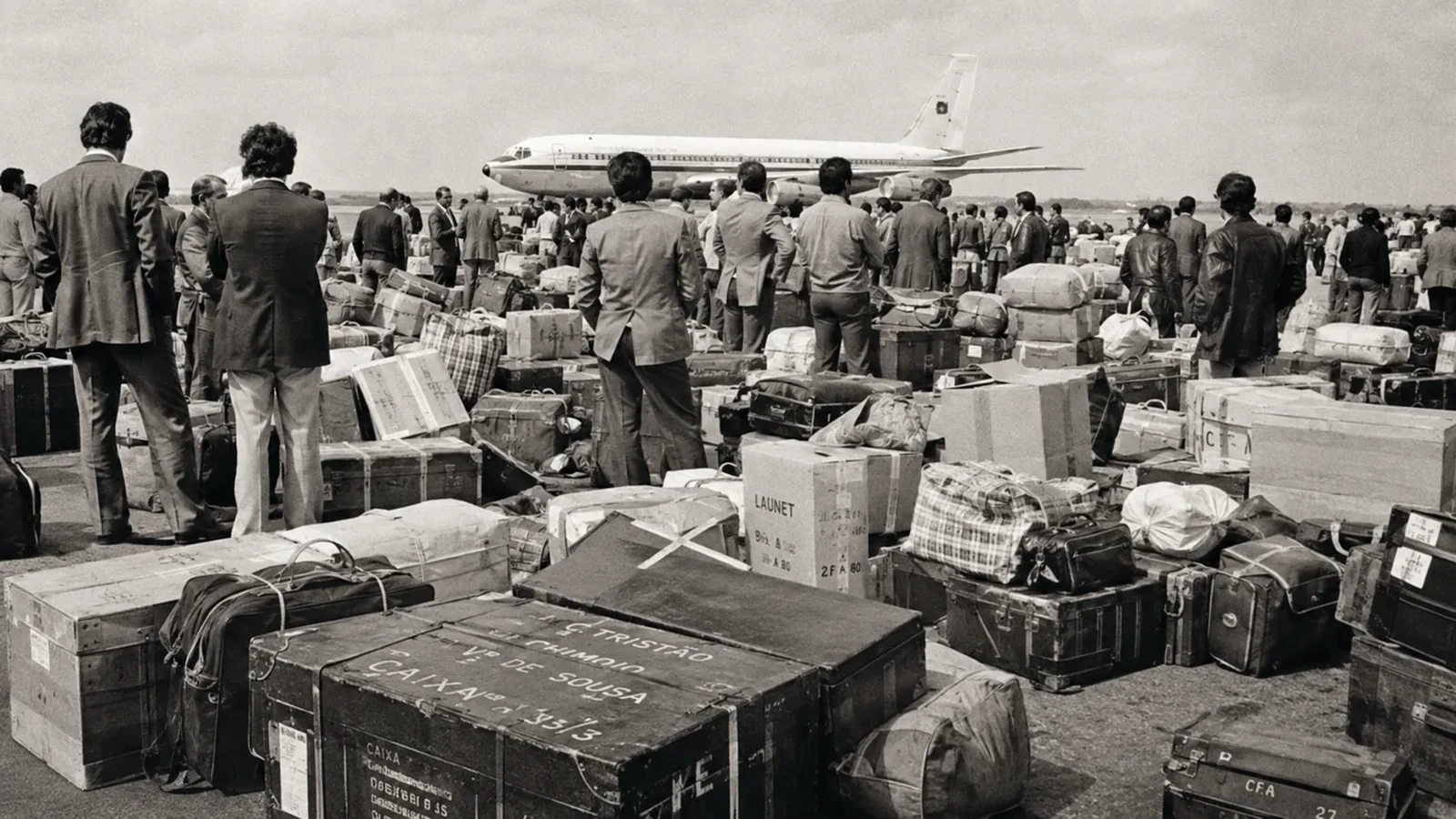
There was a year in which tens of thousands of Portuguese had to decide, in a matter of weeks, what to do with the rest of their lives. It was 1975. The Portuguese empire in Africa, which had seemed eternal, came apart in months, and the families living in Angola and Mozambique found themselves before a question that could not wait: where to go now.
Most went to Portugal, the metropole, a homeland many had never set foot in. But not all. A portion of these families looked at the map and made a different calculation. They had been in Africa for years, some for generations, they thought of themselves as in some way African, and returning to a Lisbon they did not know, and that might receive them as strangers, did not seem the only way out. It was then that many asked, and why not South Africa, right next door, where a Portuguese community had been established for decades. That choice, made in the midst of chaos, is the origin of one of the least-told chapters of the Portuguese diaspora.
To understand this exodus, we need to distinguish two movements often treated as one, because they were different in origin, in profile, and even in the way they arrived: those who came from Mozambique, and those who came from Angola.
Those who came from Mozambique
Those from Mozambique arrived a little earlier, because decolonization there happened about six months sooner, and they arrived in greater numbers. Geography was on their side. Mozambique borders South Africa, and for many it meant simply crossing the border. Many were middle-class, and already knew the neighboring country. Many spoke some English and already had contacts across the border, making settlement faster and less difficult. Some opened businesses serving the Portuguese community itself, fishmongers, florists, shops selling goods imported from Portugal. The crossing was, for many, almost direct, and border controls with Mozambique were far less restrictive than those awaiting the ones coming from the other side of the continent.
Those who came from Angola
Those from Angola had a harder road. Angola lies far from South Africa, and between the two countries stood Namibia, then administered by South Africa and kept under military watch. Many Angolans had to pass through there, and some through refugee camps, before being admitted. They were, on average, a group with a higher proportion of professionals and members of the colonial middle and upper classes, people whom Angola's colonial structure had drawn over the decades. Many arrived with qualifications and professional experience, but not necessarily with money, and some endured real hardship before rebuilding their lives.
The border, remembered
It is here that the story takes on a human dimension no statistic can capture, one preserved above all by oral history, by the testimony of those who lived it. Entry into apartheid-era South Africa was not simply a matter of documents; race could shape whether a person was admitted at all. A researcher who gathered dozens of these stories recorded the case of a Portuguese man from Angola who had to hide his own uncle in the boot of the car to cross the border, because he feared the border guards would refuse his uncle entry because of the color of his skin. She recorded the elite family that, foreseeing decolonization, had already bought property in South Africa in advance and arrived with a financial safety net. And she recorded the woman who wanted to go to Portugal but had no money for the ticket, and ended up going by car, with her family, to the nearest neighboring country. The same decolonization, entirely different choices, dictated by class, by color, by money, by luck.
The returnees who left again
There was also a quieter third movement within the same wave. Portuguese who first went to Portugal, as expected, and who did not fare well there. They arrived as retornados, the returnees, a word that in those years carried stigma and a sense of rejection, they felt like strangers, struggled to find a place for themselves, and then decided to set out again, this time for South Africa. The community kept in touch, news of the difficulties in Portugal traveled from family to family, and many preferred to begin again in an African country rather than persist in a metropole that would not take them in. The return, for these, was only a stopover.
The community they built
In South Africa, the newcomers from Angola and Mozambique did not repeat the path of the Madeirans who had preceded them. Where the earlier wave had consisted largely of farmers and small traders, many of these newcomers were professionals and technically qualified workers, who moved into technical work, management and services, though many took time to get there. And they were supported, at first, by the local Catholic church, formed in large part by the very Portuguese already in the country, many of them Madeiran, who saw fellow Portuguese in the newcomers and helped them, despite the differences. It was through these Portuguese ties, this network of faith and shared origin, that many secured the documents they needed to remain legally.
These people built, together with those already there, the community one sees today in Johannesburg, with its neighborhoods, its fishmongers, its pastry shops, its football clubs, its Masses in Portuguese, a whole Portuguese-speaking world inside an African city. But the community was not without internal tensions, and memory does not erase them. Madeirans, Angolans and Mozambicans did not always mix easily, and differences of class and origin created nicknames, rivalries and social distance that only time softened.
What the suitcase could not carry
What matters, for those who today descend from this third wave, is a truth that the chaos of 1975 hid but did not erase. Those families came from a Portuguese colonial world, and the Portuguese colonial world was, above all, a world of records. Birth under Portuguese administration meant entry into a bureaucratic system that recorded births, marriages and deaths, that issued documents. decolonization was abrupt, the departure was hurried, many people left with a suitcase and little more, and it is true that documents were lost along the way. But losing the document one had in hand is not the same as there never having been a record. The registers of origin were drawn up in their time, and those records can still make reconstruction possible decades later, even with the person now far away, in South Africa, in Canada, in Australia, or in Brazil.
Historical and genealogical research does not guarantee that a document is sitting in an archive waiting to be found. It starts with what remains: a name, an approximate date, a colonial city of birth, a family trace, and follows those clues back toward the place of origin. Sometimes the road leads to Angola, to Mozambique, and from there, further back still, to Madeira or to the mainland from which the family had departed a generation earlier, because many of these families were themselves migrants within the Portuguese world. They had gone from Portugal to the colony, and from the colony to South Africa.
For the descendant who grew up hearing that the family came from Angola, or from Mozambique, and who believed that the turmoil of 1975 had cut the thread for good, the conclusion is different. The hurried departure was the end of a world, but it need not be the end of the story. It can be, on the contrary, the point from which a new search begins. The hurried suitcase could not carry the archive with it, but the record remained behind, waiting to be found again.
Reconstructing that path, from South Africa back through Angola or Mozambique and, in many cases, further to Madeira or mainland Portugal, is the work of historical research, and it is precisely what we do at Mnésis.
Mnésis, documentary, genealogical, and historical research. From your roots to your future.
Sources & Further Reading
- Pereira, Cláudia. A imigração na África do Sul englobou em grande parte o movimento de portugueses a partir de Moçambique e de Angola, entrevista a Pamila Gupta. Observatório da Emigração, 27 July 2012.
- Bessa, Paulo. A diáspora invisível? Política e lusitanidade na África do Sul, da descolonização à democratização. Lusotopie, XVI(1), 2009.