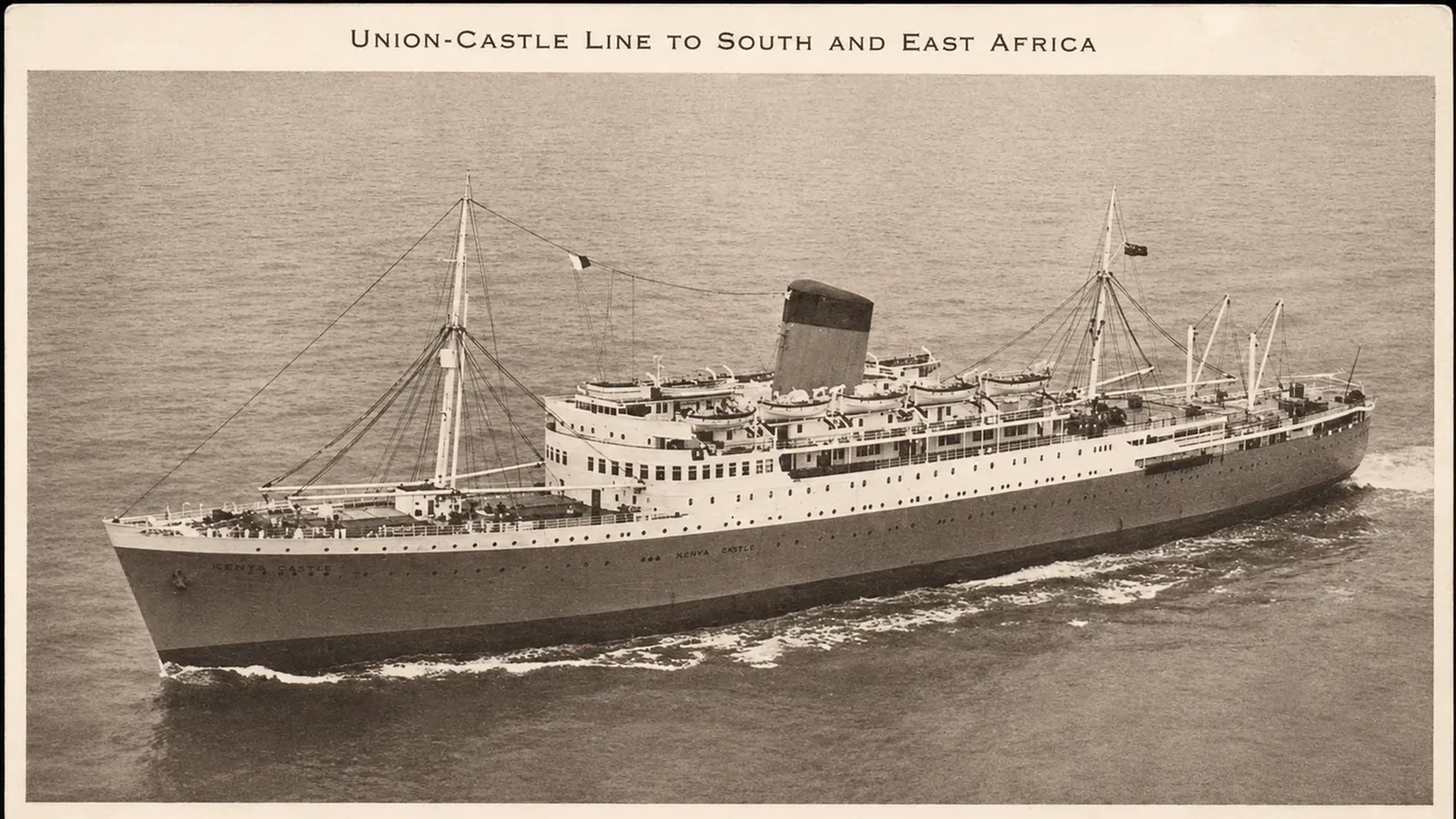
On Madeira there was a day that never appeared on any calendar, yet everyone knew it. It was the day of São Vapor, the day of the Steamer. It was no saint. It was a ship. When the great steamers of the Cape route, the ones that linked Europe to southern Africa, called at the port of Funchal, the whole island took notice, because that ship was the promise of departure for some and the promise of news for others. On one side lay an impoverished Madeira, short of work and battered by drought. On the other, across the sea, lay a land where it was said a man could begin again. Many Madeirans set out after that promise. Not all of them could set out through the front door.
Here begins a story that is rarely told in full, because part of it is uncomfortable. A large share of Madeiran migration to South Africa was undocumented at the border. The reason matters, because it changes what undocumented means in this story.
A rule that measured people by what they could read
South Africa, in the early twentieth century, put up barriers to entry. To land legally at the Cape, an emigrant had to be literate, hold certain qualifications, and show means of subsistence. Now, most of the Madeirans who wanted to leave met none of those conditions. The numbers are stark, and they are documented: in 1909, of 8,436 emigrants leaving the islands, only 1,972 could read. The overwhelming majority were illiterate, not for want of intelligence, but for want of schooling, on a poor island where children went to the fields and the sea long before they went to school. These people had no way of meeting the literacy requirement of South African law. The front door was shut to them by a rule that measured people by what they could read, not by what they could do.
The jump through Mozambique
And so these people came in through the back door. Some traveled as stowaways aboard the very steamers that called at Madeira. Others took a longer and more ingenious route, going first to Mozambique, which was a Portuguese colony and where entry was easy, and from there making what came to be known as the jump, the clandestine overland crossing into South Africa. Mozambique became, in the Madeirans' own words, the land of the jump. Networks facilitated the crossing, at a high price, from eight to thirty contos de réis, and there were also people who forged passports. In 1904 it came to light that a Madeiran from Tábua, Manuel de Abreu, a former police corporal and interpreter in the administration of Lourenço Marques, was procuring false passports, for five to thirty pounds, for countrymen who wanted to jump across into the Transvaal.
The contemporary press recorded these episodes by name and date. That is the material from which individual histories can be reconstructed. In January 1897, six Madeirans, all natives of Estreito da Calheta, were detained aboard the steamer Trojan, among them Manuel Pereira Serrão, António Gonçalves Salgado, Manuel Lourenço, Domingos Lourenço, and João Luís. In September 1903, a young man from Ponta do Pargo, João Gonçalves Serrão, and two others from Calheta were repatriated on the steamer Norman for having embarked clandestinely. These are the names of ordinary people, people who tried, who were sometimes turned back, and who often, on the next attempt, got through.
Tragedy, and the red tiles of those who returned
There were tragedies in that crossing, and there were dreams. On 17 October 1894, Maria Júlia Rodrigues left Funchal aboard the steamer Scott to join her husband at the Cape, and one day before arrival she threw herself into the sea and died, no one knows why. On 27 December 1905, António Baptista, after seven years in South Africa, returned to surprise his family in Camacha, and on reaching the house found that his wife had died only moments before he arrived. But for every tragedy there was the opposite image, that of the emigrant who returned successful. And that image too had a visible mark, so visible that it changed the landscape of the island.
Those who succeeded in South Africa came back and built. The house of a prosperous returnee carried a sign the whole parish recognized: the Marseille tile, a reddish roof tile covering the new stone-and-lime houses built with money earned at the Cape. As early as 1898, Manuel Gonsalvez Guerra was buying a building in the town of Porto Moniz, recorded as recently arrived from the Cape of Good Hope. The emigrant who had succeeded paid for the feasts of the homeland. The feast of Nossa Senhora da Graça in Estreito da Calheta, in 1904, was funded by a group of emigrants at the Cape, who asked that it be held with a solemnity such as that parish had never seen. The red tile and the sponsored feast were visible proof that the emigrant dream had paid off, and they served as encouragement for others to follow the same road.
Where they came from
Where exactly did these people come from? They came from parishes that can be named one by one, and this is the key to everything that follows. The Madeiran passport applications, kept since 1872, show a strong concentration in Estreito da Calheta, far ahead of the rest, followed by Prazeres and Fajã da Ovelha. And they include people from Jardim do Mar and Paul do Mar, which is no small detail, because these were fishing communities, and they help explain why the Madeirans came to dominate the tuna and lobster fisheries at the Cape. They also include people from Ponta do Sol, Ponta do Pargo, Prazeres, Caniço, and Camacha. Each of these parishes sent its people across the world, and each of them preserved traces and memories of those who left.
What "undocumented" really means
And this is where the word undocumented needs to be unpacked, because it can mislead. The Madeiran who jumped across from Mozambique, who came in hidden aboard the steamer, who had no paper in hand when he set foot at the Cape, was undocumented at the point of arrival. He was not, and never was, a man without an origin. His irregular entry was a fact of the South African border regime; it did not erase his Portuguese identity. That man had been born in a parish of Madeira, had been baptized in a church of Madeira, had his name entered in a Madeiran parish register, and often had even applied for a passport, which was recorded, even when he used it for one destination and ended up in another.
The border entry was clandestine. The birth record was not.
This is the difference that changes everything for those who descend from these people today. The clandestine entry did not erase the thread; it merely hid where it began. And the beginning is still there, in the parishes, in the baptismal registers, in the parish registers, in the passport indexes. It is not about promising that the document is stored away and waiting, intact, with the grandfather's name on it. It is something more honest and more real: the clues remain, the surname, the likely parish, the approximate date, the trace of the family itself, and from them the trail can be reconstructed. This is exactly what historical and genealogical research does: it takes the small traces that remain and reconstructs the trail back to the place of origin.
That work is not limited by where a descendant lives today. The descendant of that Madeiran who jumped across from Mozambique in 1950 may now live in Johannesburg or in Cape Town, in the neighborhood once called Little Madeira, in Woodstock. They may equally live in Canada, in Australia, in Britain, in Brazil, because many of these families moved again, left South Africa and began anew elsewhere, carrying the surname and leaving behind, once more, the trace of where they had come from. The origin did not move. It remains in the Madeiran parish where it all began.
For those who grew up hearing that their grandfather entered South Africa clandestinely, that the name was lost, that the family arrived without papers, the truth may be the opposite of what family memory suggests. The clandestine entry is not the end of a road. It can be, on the contrary, the beginning of a journey back to one's origins. What the family treated for decades as a stain on the family story, the grandfather who came in through the back door, may become the very doorway back into the family story, this time to find the parish, the name, and the story that was never truly lost at all.
Reconstructing that trail, from a South African family name back to a parish in Madeira, is the work of historical research, and it is precisely what we do at Mnésis.
Mnésis, documentary, genealogical, and historical research. From your roots to your future.
Sources & Further Reading
- Vieira, Alberto. Da Madeira a Cape Town, República da África do Sul. Cadernos de Divulgação do CEHA, Centro de Estudos de História do Atlântico, Funchal, Projeto Memória Nona Ilha.
- Bessa, Paulo. A diáspora invisível? Política e lusitanidade na África do Sul, da descolonização à democratização. Lusotopie, XVI(1), 2009.