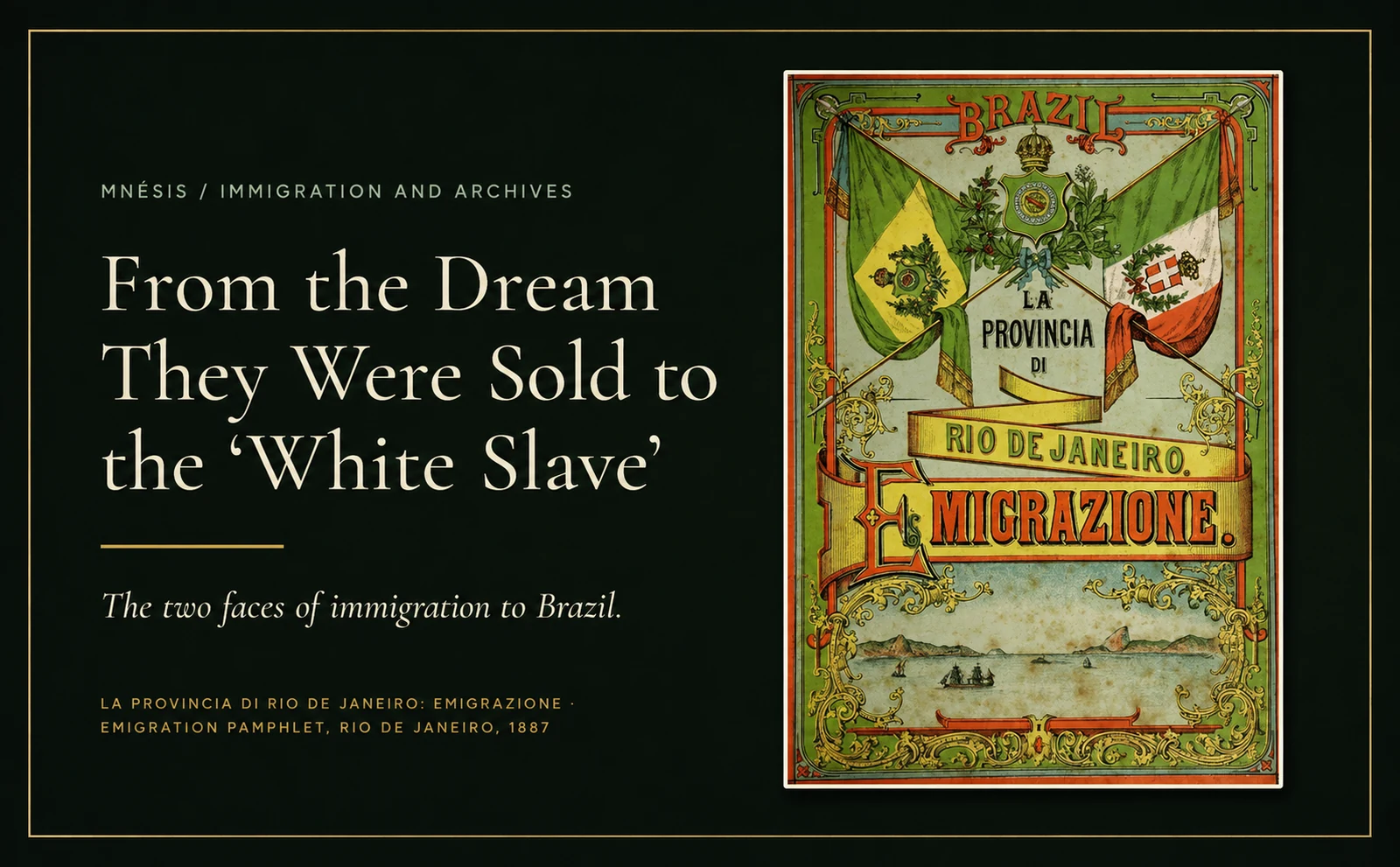
Almost every family remembers its immigration story as an epic. The grandfather who crossed the ocean alone, armed only with courage and the hope of a better life. It is a beautiful story, and it is half a story. What he found on the other side of the crossing is rarely told. And what the documents reveal about the other side is far less romantic than family memory chose to preserve. There is, moreover, a historical proof of how hard that experience was, and it is an unavoidable one: the European governments themselves, the countries these people left, eventually went so far as to restrict or prohibit subsidized emigration to Brazil. These restrictions were not imposed because Brazil had proved too prosperous, but because reports of abuse had become impossible to ignore.
The hardship began before boarding, in the very decision to leave. Many did not leave by informed choice, but by deception. In the villages of Galicia, of Andalusia, of the Veneto, recruiters known as ganchos, literally hooks, moved through the countryside, men hired by the shipping companies and by the agents of the governments that needed labor. They moved through the countryside making promises that reality would not fulfill. A Spanish official source recorded what they spread: that the government of Brazil would give the emigrants land, cattle, tools, a house and even money to live on.¹ Official propaganda went with them, with posters that sold Brazil and Argentina as paradises of work and wealth. One scholar summed up the phenomenon well when he said that Italian migration was often born of a deception: the worker was offered the cuccagna, the land of plenty, when what he found was a condition worse than the one he had left.² Many emigrants therefore boarded the ship already under false expectations.
To understand what awaited him, one must understand why Brazil wanted him. The mass arrival of Europeans for the coffee plantations was no accident; it was, to a considerable extent, a way of replenishing the labor force of the coffee economy after emancipation. With the end of slavery, the coffee planters found themselves without the labor on which they had built their wealth, and set about replacing it. European immigrants were brought in, in large part, to occupy the productive and social place that the African slave, freed only a few years before, had left vacant. And here is the point historians have stressed with force: because he occupied that same place, the immigrant was often seen and treated by the planters in the same way as their former captive property. Some researchers coined harsh expressions for him: the novo negro, the “new black” who had replaced the freed slave, and the “white slave” (escravo branco).³ The expression is harsh, and it comes from the historians themselves; using it, including in the title of this article, is not a search for shock, but a way of naming with precision a comparison the documentation imposes. It requires, however, a clear caveat: African slavery legally reduced human beings to property, and the immigrant was not, in law, a slave. But in the practice of the plantations, in the treatment, the humiliations, the violence and above all the mechanism of debt, the line between one thing and the other was, for many, painfully thin. In many labor arrangements, travel costs, advances and supplies were converted into debts that tied immigrants to the estate, forcing them to remain in conditions they had not chosen.
It is not today's historian who invents this picture; contemporary witnesses denounced it from within the system itself. In 1902, the Italian government sent two agents to Brazil to verify on the ground what its emigrants were living through. One of them, the journalist Adolpho Rossi, was assigned to investigate the coffee plantations of São Paulo. His report circulated widely in the Italian and Brazilian press and drew the darkest possible picture: it described the plantations as unhealthy places, where labor relations were marked by treatment that Rossi compared to that inflicted on enslaved Africans, with humiliations, physical and psychological abuse, and the failure to pay the wages owed. Rossi went so far as to close his report by stating that Italian emigration to Brazil was a crime.⁴ It would be unfair, however, to stop there, and rigor requires showing the other side. The authorities and the press of São Paulo reacted vehemently, and not without some reason: they published figures showing prosperous Italian colonies, immigrants who had become rural landowners, commercial houses and industries founded by people from the peninsula.⁵ The outcome was not universally bleak; some immigrants did prosper. The fuller picture is neither the catastrophe Rossi described nor the idyll the São Paulo press sought to promote. It is one of extensive and well-documented exploitation, from which some, with luck and time, eventually managed to achieve economic and social advancement.
And there was the crossing, which was itself an ordeal. Most emigrants traveled in third class, the steerage, the crowded steerage compartments of the large steamers that linked Europe to Brazil, the very ones that, in the peak years, carried more than two thousand emigrants on a single voyage. Conditions on board could be atrocious. The Bulletin of the Spanish Higher Council of Emigration went so far as to condemn ships for their conditions: a Norwegian steamer, the Amanda, became known as the barco ataúd, the coffin ship, for having neither berths nor ventilation and never being washed. And there was the case of the French steamer Italie, in whose holds dozens of corpses were found on arrival at the port of Santos.⁶ These are extreme cases, not the rule of every voyage, but they show what overcrowding and neglect could produce, and they explain why the regulation of emigrant voyages became a matter of government concern.
We thus reach the most eloquent proof of all, the one with which I opened this text. If the experience had been good, or merely hard but fair, the countries of origin would not have acted. But they did act, despite their own interest in relieving demographic pressure. Italy took one of the most consequential early measures. On 26 March 1902, the Italian Emigration Commissariat signed the document that became known as the Prinetti Decree, though technically it was an administrative order, banning subsidized emigration to Brazil.⁷ Note this: it did not ban spontaneous emigration, only the subsidized kind, the form most closely tied to recruitment and debt-based labor arrangements. The impact was immediate and brutal. In the year before the measure, 59,869 Italians had entered Brazil; in the first year the law was fully in force, 12,970 entered.⁸ Spain followed the same path. On learning of the harsh conditions on the São Paulo plantations, the Spanish government banned, in 1910, emigration with paid passage to São Paulo, and two years later made the very activities of the ganchos illegal.⁹ The countries these emigrants had left looked at what they were encountering overseas and moved to restrict the flow. It is perhaps the coldest evidence of how serious conditions had become on the other side of the Atlantic.
But a migration stream, once established, cannot simply be stopped by decree. Where there was a ban, a way around it was found. The Andalusians took to leaving through Gibraltar, British territory beyond the reach of Spanish oversight, going overland to the border to embark on English soil; the Galicians made similar use of the port of Leixões, in Portugal.¹⁰ Part of the migration continued through clandestine or evasive routes, driven by the same need as ever. And there were those who came back. Many did not reach the dream sold by the ganchos and returned, or re-emigrated: nearly half of the Spaniards who left Brazil in the first decades of the twentieth century went on to Argentina, in search of opportunities they had failed to find in Brazil.¹¹ For those who wished to return to their native land and lacked the means, there sometimes remained the mutual-aid societies, associations formed by the immigrants themselves, some of which helped finance the return of immigrants whose experience abroad had ended in failure or hardship. But that is another story, and it will deserve its own text.
In the end, the essential thing remains. Understanding the hardships an ancestor endured does not diminish him; if anything, it enlarges our understanding of his courage. It did not lie in boarding toward a promised paradise, because that paradise did not exist. It lay in surviving a deception, in resisting exploitation, in building something out of almost nothing, and in persisting until the children and grandchildren had, at last, the life the propaganda had promised him. The romantic story honors a dream. The true story honors a man.
Sources
- Spanish official sources on the activity of the ganchos and the promises spread to emigrants; see also the study of Spanish immigration in the interior of São Paulo, Revista Contemporânea, and the dissertation on the Spanish community in Brazil.
- Beneduzi, Luís Fernando, on migration as a space of deception and the notion of the cuccagna promised to the Italian emigrant; in L'America Latina: la violenza e il racconto, Venice, 2012.
- Beneduzi, Luís Fernando, “Alteridade e estranhamento: a figura do novo negro na imigração italiana no Brasil”, MÉTIS: história & cultura, v. 13, no. 27, 2015.
- Report of Adolpho Rossi to the Italian Emigration Commissariat, 1902, as circulated in the Italian and Brazilian press; see Balbinot, Giovani, “Detratores e defensores da imigração italiana para o Brasil: o Decreto Prinetti de 1902 e a Exposição Mundial de 1906”.
- Correio Paulistano newspaper, São Paulo, June 1902, inquiry into the conditions of Italian immigrants.
- Bulletin of the Spanish Higher Council of Emigration, on the steamers Amanda and Italie and the conditions of third class.
- Administrative order of the Italian Emigration Commissariat, signed on 26 March 1902 (Prinetti Decree), banning subsidized emigration to Brazil.
- Aliano, David, “Brazil through Italian Eyes”, on the impact of the Prinetti Decree on the migratory flow; figures cited in Balbinot.
- Spanish Royal Decree of 26 August 1910, banning emigration with paid passage to São Paulo, and 1912 legislation against the ganchos; see the study of Spanish immigration in the interior of São Paulo, Revista Contemporânea.
- Museo de Ecología Humana, on Gibraltar as a port of clandestine emigration; and the account of the Galicians' departure through Leixões, Revista Contemporânea.
- Sánchez Alonso, Blanca, “Algunas reflexiones sobre las políticas de inmigración en América Latina en la época de las migraciones de masas”, Estudios Migratorios Latinoamericanos, 2004, on re-emigration from Brazil to Argentina.